
In many warehouses and factories, pallets are still wrapped by hand: someone walks bent over around the pallet, roll in hand, several times for every pallet. It looks like a cheap job, but you pay for it in wasted film, working time, loads that come apart on the road and customer complaints. This guide shows you how to work out what it costs you, which type of pallet wrapper suits your pallets and what information to prepare before you ask for a quote.

What does manual pallet wrapping cost you?
Manual wrapping costs you mainly in film, time and damaged pallets. By hand, stretch film barely stretches: packaging industry sources put it at around 10–20% at most. A machine with powered pre-stretch stretches the film 2.5 to 4 times before it goes onto the pallet. At 250% pre-stretch, one metre of film from the roll becomes 3.5 metres on the pallet. You see the difference directly in the kilograms of film you buy every month.
Besides film, wrapping by hand also brings:
- working time: the person wrapping does nothing else, and at shipping peaks pallets wait in line;
- quality that depends on the person: a pallet wrapped on Monday morning does not look like one wrapped on Friday evening, at the end of the shift;
- pallets that come apart or lean in transit, with returned goods, complaints and sometimes penalties from the customer;
- physical strain: walking bent over around the pallet and pulling the film loads the back and shoulders, day after day;
- lost rolls: rolls dropped, damaged or started and abandoned, which never show up in any record.
Load securing is not just about appearance. The European Commission states that up to 25% of accidents involving trucks can be attributed to inadequate cargo securing. The European Best Practice Guidelines on Cargo Securing for Road Transport (2014) treat stretch film as a means of stabilising the pallet.
How do you calculate the savings for your warehouse?
Put numbers on two costs: film and labour. Example, with assumptions you replace with your own data: 40 pallets a day, 250 working days a year, 0.5 kg of film per pallet wrapped by hand, film at EUR 2/kg, 40% less film used on the machine and 3 minutes of work saved per pallet, at a labour cost of EUR 8 an hour.
- pallets a year: 40 × 250 = 10,000;
- film: 10,000 × 0.5 kg × EUR 2 = EUR 10,000 a year, of which you save 40%, that is EUR 4,000 a year;
- time: 10,000 × 3 minutes = 500 hours × EUR 8 = EUR 4,000 a year;
- total: EUR 8,000 a year, before counting the damaged pallets and complaints you avoid.
The 40% reduction is a cautious assumption. The real figure depends on the film you use now, on your pallet and on the wrapping programme. The surest way to find it is a test with your real pallet: weigh the roll before and after.
Calculator: how much you save with a pallet wrapper
The starting values are the ones from the example. Replace them with the figures from your warehouse.
The result is an estimate. It does not include damaged pallets, avoided complaints or maintenance and energy costs.
When is it time to stop wrapping by hand?
It is time when wrapping takes up a good part of someone’s shift or when pallets start reaching the customer damaged. The most common signs:
- someone wraps pallets for more than an hour per shift, every day;
- at shipping peaks, pallets wait to be wrapped and the truck waits for the pallets;
- you get complaints about pallets that came apart, lean or have crushed boxes;
- film consumption goes up while the volume shipped stays the same;
- you ship over long distances or for export, where the pallet goes through several handling steps;
- a large customer asks for uniformly wrapped pallets, possibly with a top sheet or corner boards.
Which type of pallet wrapper suits your pallets?
You choose the type of wrapper by the pallet: how stable and heavy it is, what shape it has and how many pallets you wrap per hour. There are four basic technologies:
| Type of wrapper | How it works | Suits | Typical volume |
|---|---|---|---|
| Mobile robot | Drives itself around the pallet, anywhere in the building | Pallets of different shapes and sizes, warehouses with no fixed wrapping station | Low to medium |
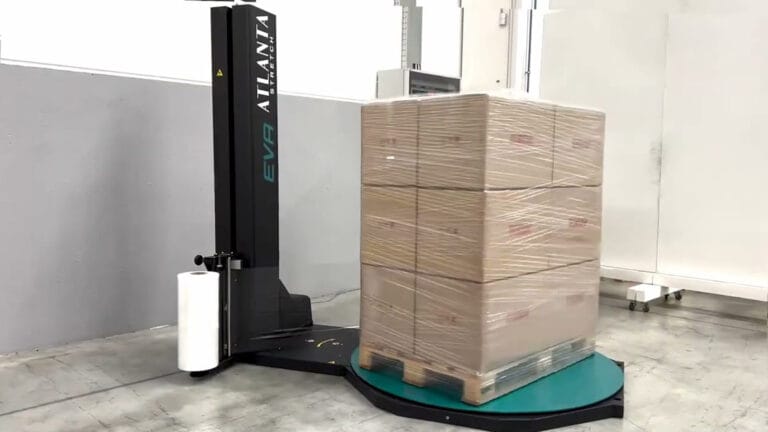
| Turntable | The pallet turns on a turntable while the film carriage moves up and down | Stable pallets: cartons, packs, bags. The most common choice | Low to high (semi-automatic or automatic in line) |
| Rotary arm | The film arm turns, the pallet stays still | Heavy, unstable or very light pallets that must not be rotated; long products | Low to high |
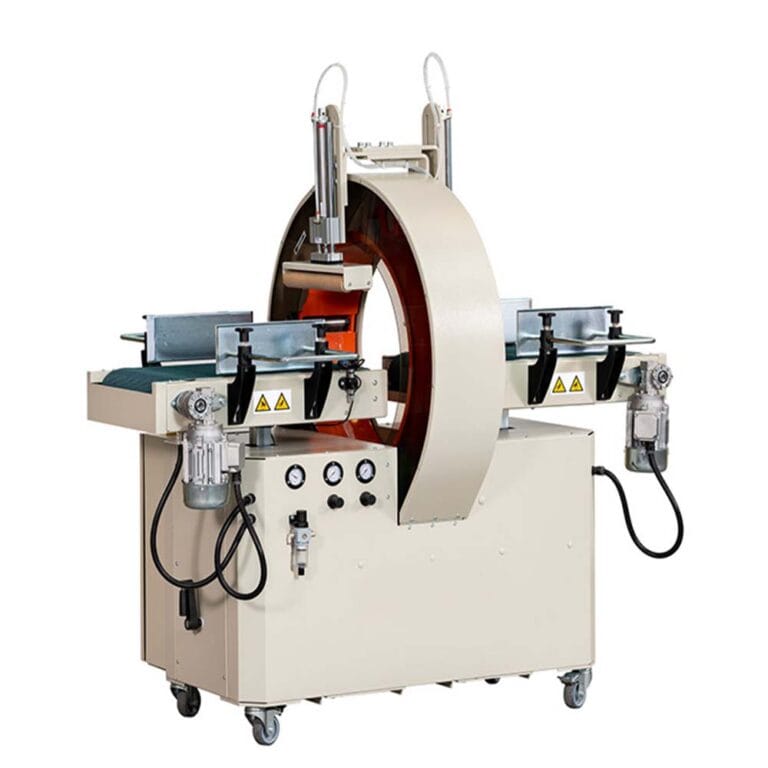
| Rotary ring | The film ring turns around the pallet standing on a conveyor | Automatic end-of-line systems with very high throughput | Very high |

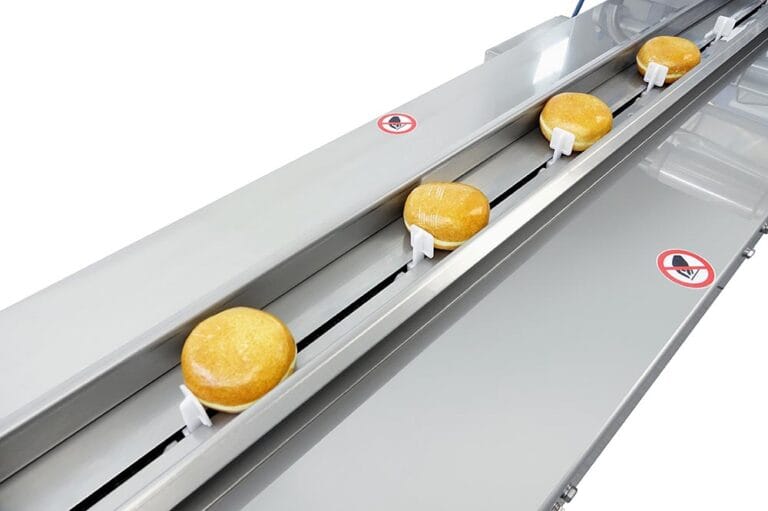
A few situations need special attention. Products that need to breathe, such as fruit, vegetables, flowers or bread, are wrapped with the film split into bands, so that no condensation forms. Fragile products (glass, ceramics, electronics) need adjustable film tension. Doors, windows and panels need large wrapping heights and a dedicated configuration.
Semi-automatic or automatic: which should you choose?
Choose by the way the pallet reaches the wrapper. If it comes on a forklift or a pallet truck, a semi-automatic wrapper is usually enough. If it leaves the line on a conveyor, an automatic wrapper built into the line is worth it.
- Semi-automatic: the operator places the pallet, attaches the film end and starts the programme; the machine does the rest. With automatic film cutting and remote start, the operator no longer has to get off the forklift.
- Automatic: the pallet arrives on a conveyor, is wrapped and leaves without anyone touching it. It suits lines with continuous flow and high volumes.
Think about the next few years as well. On many semi-automatic machines you can add options later, such as automatic film cutting or a different film carriage, without replacing the machine.
Which options are worth paying for?
The options worth paying for are the ones that solve a problem you already have. The rest only make the machine more expensive. In short:
- powered film pre-stretch: almost always worth it, because the film saving depends on it;
- automatic film cutting and remote start: worth it when the same person loads and wraps many pallets a day;
- top sheet dispenser: worth it when pallets are stored outdoors or in dusty, damp areas;
- film roping (the film gathered into a rope at the base of the pallet): worth it for loads that slide off the pallet;
- corner board applicator: worth it when the customer asks for protected corners or when pallets are stacked;
- cold-store version (down to −30°C) or stainless steel: a must in cold stores and in food areas with wash-down;
- integrated scale and labelling: worth it when the pallet has to be weighed and labelled before shipping anyway.
What information should you prepare before asking for a quote?
A sound quote starts from your pallet, not from a catalogue. Prepare:
- pallet dimensions and the maximum load height;
- maximum weight of the loaded pallet;
- what is on the pallet: cartons, bags, drums, fragile products, products that need to breathe;
- how many pallets you wrap per day and in the peak hour;
- how the pallet reaches the wrapper: forklift, pallet truck or conveyor;
- the space available and the forklift routes in that area;
- the working environment: temperature, humidity, hygiene requirements;
- the film you use now and how much you use per month;
- your customers’ requirements: top sheet, corner boards, pallet label.
A few photos of your pallets and your shipping area help more than a long description.
How do you check that a pallet is well wrapped?
A pallet is well wrapped when it arrives intact and upright after transport, using as little film as possible. More layers do not automatically mean a more stable pallet. Check a few simple things:
- the film also holds the wooden pallet, not just the goods, so the load cannot slide off the pallet;
- the layers overlap evenly, with no gaps between them;
- the corners and top cartons are not crushed by film pulled too tight;
- each pallet type has its own programme saved in the machine, used the same way on every shift;
- the first deliveries after start-up are followed up and the programme is adjusted to how the pallets arrive.
For customers who ask for formal proof, pallet stability can be tested in a laboratory using the EUMOS 40509 method, which measures how rigid the pallet stays under acceleration and braking.
How do you put the project into practice?
- Measure where you are now: how much film you buy per month, how many pallets you wrap and how long it takes.
- Collect the complaints about damaged pallets from the last year; they give you part of your case.
- Involve the shipping and logistics team. They know where the flow gets stuck and where a machine would get in the way.
- Decide where the wrapper goes together with your health and safety officer, taking the forklift routes into account.
- Ask for a test with your real pallet and compare the film used with what you use now.
- Plan the training for operators and maintenance staff, plus the film stock for the machine.
How does Imark Sistem help?
Imark Sistem is Atlanta Stretch’s partner in Romania and offers the full range of pallet wrappers: mobile robots and turntable, rotary arm and rotary ring machines, semi-automatic and automatic. We start from your pallet, recommend the technology and the options that make sense and take care of installation, training, stretch film and service.
If the pallet also has to be labelled before shipping, see our pallet labelling solutions. For more arguments, read 10 reasons to replace manual pallet wrapping. You can reach us on +40 21 255 71 74 or at office@imarke.ro.
Frequently asked questions about choosing a pallet wrapper
How many pallets a day make a pallet wrapper worth it?
There is no fixed threshold. Equipment suppliers often mention 10–15 pallets a day, but it is safer to do the calculation with your own film, time and complaints. The calculator in this guide gives you a first answer.
Can I use the film I have now in the machine?
Usually not. Pallet wrappers use machine film rolls, which are different from hand film rolls. We choose the film together with the machine, and Imark Sistem can supply the film as well.
What should I choose for unstable or very heavy pallets?
A rotary arm wrapper. The pallet stays still and the film arm turns around it, so the load is not set in motion. For pallets of very different shapes, in different places in the building, a mobile robot is more flexible.
Can pallets be wrapped in cold stores?
Yes. There are versions for cold stores and freezers, down to −30°C, with protected components and a heated electrical cabinet.
How do I wrap products that need to breathe?
With the film split into bands. The film goes on in several bands with gaps between them, so air circulates and no condensation forms. Standard stretch film is used, not perforated film.