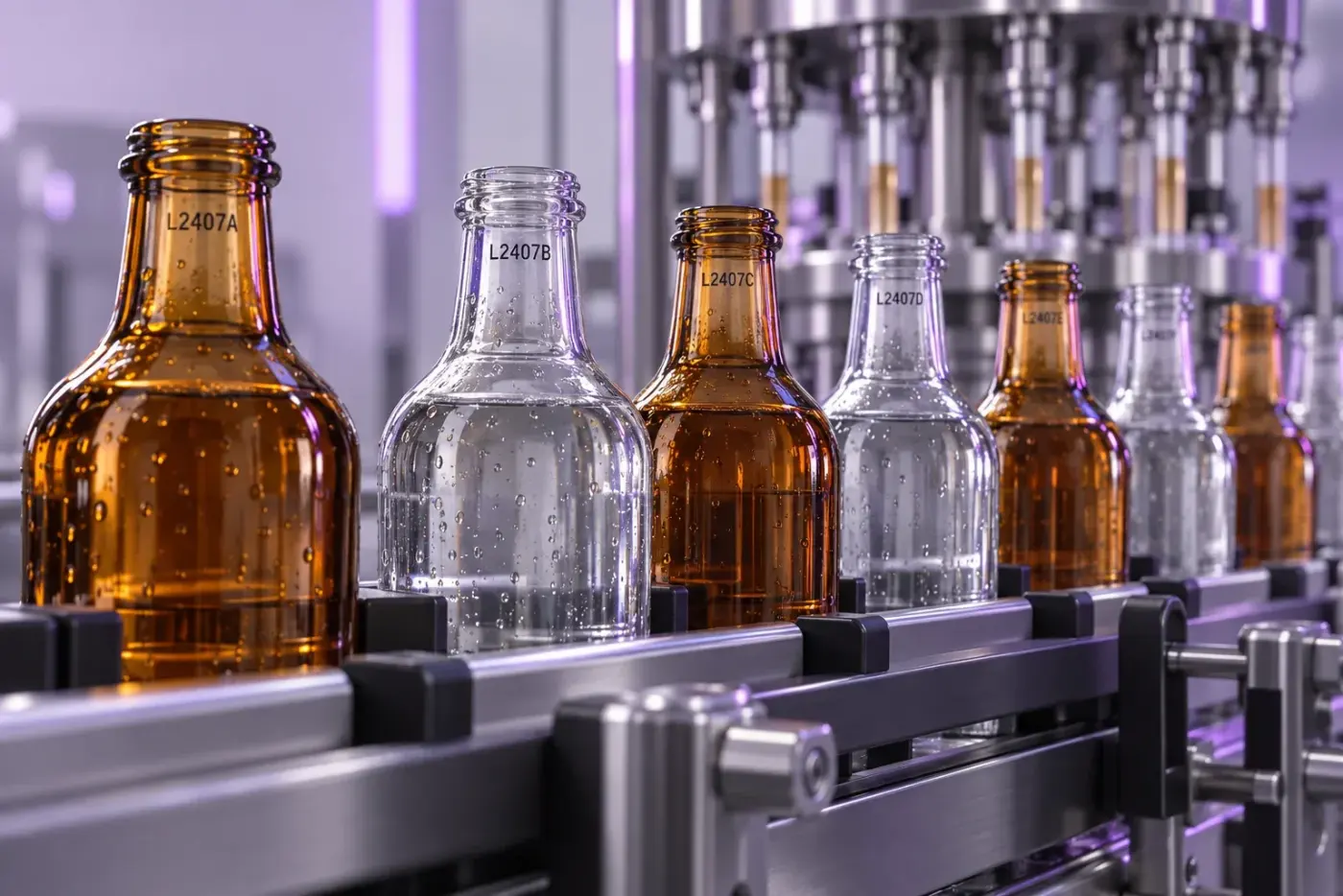

Foreign bodies
metal, glass, stone, bone
Cookies on imarke.ro
We use cookies the site and its forms need to work. Only with your consent do we use Google Analytics, to see which pages are visited, and Google Ads, to measure which ads bring quote requests. Cookie policy · Privacy
Marking & traceability
Labeling & packaging
Safety & compliance
Transport & handling
Contaminant inspection and detection · Wipotec
Detect hidden foreign bodies and check product quality directly on the production line. Wipotec X-ray inspection systems identify contaminants such as metal, glass, stone, bone and certain dense plastics in packaged, unpackaged or bulk products. Imark Sistem helps you test the application, choose the right configuration and integrate the equipment into your existing line.
metal, glass, stone, bone
packaged, bulk or upright
versions for wash-down areas
X-ray, weighing, vision
with your own product
Operating principle
An industrial X-ray system measures how much the product and the materials inside it absorb. Foreign bodies that are denser than the product absorb more radiation and stand out in the image. The software analyses every image, identifies the deviations defined for the application and triggers the rejection of the non-conforming product without stopping the line.
Depending on the product, the same inspection can be set up to check completeness, shape, position, component distribution and fill level, or to detect broken products.
The sensor is chosen for the application: a diode array detector for standard applications, the VioX camera for fast lines and the DFXr camera for low-density contaminants such as bone.
See how it works in brief: Imark Sistem presentation video on X-ray detection systems (YouTube, in Romanian).
Detection performance is application-specific

The choice starts with the product

Checks for metal, glass, stone, bone and other materials with a density different from the product, missing components, broken products, fill level, shape and position. Solution direction: the Wipotec SC-E or SC ranges, configured for product size, speed, resolution and rejection mechanism.
Send us your application details
The aim is to detect contaminants as early as possible in the process, reject the non-conforming portion precisely and lose as little good product as possible. Solution direction: Wipotec SC-B 30 for dry bulk and SC-WD-B for bulk in wash-down areas. See the Transilvania Nuts case study below.
Send us your application details
We assess the container material, base and lid, product geometry, inspection zone and stability on the conveyor. Solution direction: SC-S side-view systems with a height-adjustable X-ray source. For integration directly into filling machines there is the SC-I version.
Send us your application details
The base, walls or lid of the container have dense areas that can hide a contaminant. Solution direction: side-view systems or the SC-S 5020 Dual View, with two detectors that inspect the container from different angles. For glass-in-glass, the choice is confirmed by tests.
Send us your application details
We assess the protection class, hygienic design, access for cleaning, component resistance and the line cleaning procedure. Solution direction: the SC-WD range, with IP69K protection, a tool-free removable belt and a C-shaped product chamber.
Send us your application details
X-ray plus weight control and/or optical inspection without three separate machines: SC-W combines X-ray with checkweighing, SC-V with optical inspection and SC-W-V with both. You save line space and work from one common interface; the exact functions are confirmed for each configuration.
Send us your application detailsQuality problems solved
Materials denser than the product they are in: ferrous and non-ferrous metals, stainless steel, glass, stone, calcified bone and certain dense plastics. The actual sensitivity is established by testing the application.
Missing components, broken, deformed or misplaced products, under- or uneven filling, ingredient distribution and, where the application allows, the presence of clips.
The mechanism is chosen according to the weight, speed, stability and packaging of the product: air jets, pusher, flaps or other systems. Secure collection of rejected products is part of the line analysis.
Depending on the configuration, the software can store the images of rejected products with date and time. Archiving, access, reporting and integration into your network are defined in the project phase.

Foreign bodies, shape check, broken products and surface control.

Foreign bodies, box completeness, shape and position of every piece.

Foreign bodies, broken products, nut distribution and completeness.

Foreign bodies, fill level and tray completeness.

Foreign bodies and product density measurement.

Foreign bodies, clip and fill level control, missing clip detection.

Foreign bodies in sliced product packed in film.

Foreign bodies and quantity control in every compartment.

Foreign bodies and pack completeness.

Foreign bodies, portion completeness and broken products.

Foreign bodies in raw materials, before processing or packaging.

Foreign bodies, completeness, broken tablets and leaflet presence.
Applications by industry
Inspection takes place before packaging, at high throughput and with minimal loss of good product.
Lines often run in wet areas, with intensive sanitation and density variations.
High humidity, wash-down and strict hygiene requirements.
Yoghurts and products in trays, portioned or sliced cheese.
Bread, baked goods, bars, biscuits, pralines, chocolate and snacks.
Pizza, meal trays, portioned and frozen products.
Many recipes, densities and formats on the same line, from light packs to large bags.
The technology is also used for pharmaceuticals, consumer goods and industrial applications, for example to check completeness and components.
Choosing the technology
| Need | Usually suitable technology | Note |
|---|---|---|
| Ferrous, non-ferrous and stainless steel metals | Metal detector or X-ray | The choice depends on product, packaging and required sensitivity. |
| Glass, stone, calcified bone and metal | X-ray | The material must have a density sufficiently different from that of the product. |
| Product in metallised film or aluminium tray | X-ray or Multispectrum metal detector | For metallised film, a CEIA Multispectrum metal detector can work under certain conditions. Aluminium trays are inspected with X-ray. The application is tested. |
| Colour, label, text or outer appearance | Vision system | The camera analyses the visible surface, not the inside of the product. |
| Contaminants plus label or weight checks | Combined system | X-ray with optical inspection and/or checkweighing in a single configuration (SC-V, SC-W, SC-W-V). |
There is no universal technology for every risk
Wipotec and Imark Sistem
Configurations for horizontal, upright and bulk products, wash-down areas and combined systems, built on the same core segment.
Algorithms and functions adapted to the application and recipe. The system automatically creates the product spacing needed for inspection.
The rejection mechanism is chosen by format, mass, speed and stability, with optional reject confirmation.
We assess space, conveying, working height and interfaces so the system fits into your current flow.
Trials with the products and contaminants relevant to your application, including with the Wipotec demo truck brought to Romania by Imark Sistem.
Consulting, installation, commissioning, operator training and service in Romania through Imark Sistem.
Support for food safety programmes
Selection and implementation
We establish the target contaminants, relevant sizes, control point, quality requirements and how non-conforming products are handled.
We assess recipe, density, dimensions, orientation, packaging, format variations and environmental conditions.
Speed, throughput, product spacing, working height, available space, flow direction, utilities and integration requirements.
We test representative samples and reference contaminants and monitor detectability, stability, reject rate and loss of good product.
We choose the sensor, aperture, conveyor, radiation shielding, software and rejection mechanism.
We coordinate integration, commissioning, operator training and ongoing technical support, as agreed in the project.
Case studies from Romania
Transilvania Nuts · Wipotec SC-B 30
Challenge: the raw material comes from different regions and can contain stone, glass or metal. The line runs 24/6, so reliability and continuous flow are essential.
Solution: a Wipotec SC-B 30 integrated directly into the line to inspect walnut kernels before packaging, with rejection by stainless steel air nozzles. The equipment was tested on the real product during the Wipotec demo truck visit, before the decision.
Result: 1.5 tonnes of walnuts inspected per hour, dense contaminants removed with minimal product loss and without interrupting the flow. Imark Sistem provides remote maintenance and technical interventions.
Even though it is a complex system, the implementation went smoothly thanks to the professionalism and technical knowledge of Wipotec and Imark Sistem.
SanoVita · Wipotec SC 3000
Challenge: a wide range of plant-based products with different densities, sizes and packaging, inspected on the same lines without stopping production.
Solution: two Wipotec SC 3000 systems, each integrated into an existing line. The configuration has a vertically offset infeed and outfeed and shortened radiation protection curtains to fit the available space. Rejection combines a pusher with air blast nozzles, adapted to the format.
Result: 100 g superfood packs and 1,000 g cornflake bags checked for metal, glass and stone without interrupting the flow. Imark Sistem carried out the installation and provides local service and technical support.
We needed a system that could check very different product formats. With the SC 3000 X-ray system, we can now inspect both large and small packaging without interrupting the production flow or compromising on accuracy.
FAQ
Depending on the application: ferrous and non-ferrous metals, stainless steel, glass, stone, calcified bone and certain dense plastics. Detectability also depends on size, density, product, packaging, orientation and speed.
It can detect certain plastics whose density is sufficiently different from that of the product. Low-density plastics can be hard or impossible to detect, so we run a test with the real material that represents the risk in your process.
Yes. X-ray is suitable for both metallised film and aluminium trays and containers. For metallised film, a CEIA Multispectrum metal detector can work under certain conditions; for aluminium trays, X-ray inspection is the solution. The result depends on the product, the pack geometry and the target contaminant.
A metal detector specialises in metal contaminants. An X-ray system analyses density differences and, besides metal, detects glass, stone, calcified bone and other dense materials. It can also check integrity, fill level or completeness.
Yes. Depending on the product and software, it checks the number of components, shape, position, distribution, fill level and broken or incomplete products.
Automatically, by a mechanism chosen for the application, such as air jets, a pusher or a flap. The choice depends on weight, speed, stability and type of packaging.
X-ray inspection does not make the product radioactive. No adverse effects on food, beverages, drugs or cosmetics are known from scanning with enclosed inspection systems. The equipment is installed, checked and operated according to legal requirements and the manufacturer’s instructions.
Yes, if space, working height, speed, product conveying, pack spacing, utilities and the rejection mechanism are assessed correctly. For tight spaces there are combinations with checkweighing or optical inspection.
Through risk analysis and tests with real products and reference contaminants. A generic value from a datasheet cannot replace validation on your recipe, packaging and line speed.
The product and packaging, dimensions and weight, target contaminants, speed or throughput, product spacing, available space, flow direction, wash-down conditions and, if available, photos or a video of the line.
Every X-ray application is different. Tell us what product you inspect, which contaminants you target, the packaging, line speed and available space; you can attach photos, a sketch or a video. An Imark specialist will recommend the steps for testing and configuration.
Fast response · free consultancy · dedicated technical support