
25-kilogram sacks, full crates, drums, rolls of film: in many factories these loads are still lifted by hand, tens or hundreds of times per shift. The cost does not appear on a single line of the budget, but you pay it through sick leave, people who leave, posts that are hard to fill and a pace that drops towards the end of the shift. The guide below shows you how to calculate this cost, what the law says and when a lift or a manipulator makes sense.

What does manual lifting actually cost you?
Repeated manual lifting costs you mainly through people: absences, departures and productivity. Musculoskeletal disorders, especially back problems, are the most common work-related health problem in the European Union, according to the European Agency for Safety and Health at Work (EU-OSHA). In the factory, this means:
- sick leave at physically demanding posts, which you have to cover with overtime or with people moved from other posts;
- staff turnover: heavy posts are the first ones people leave, and every replacement means recruitment and training;
- posts you cannot fill with just anyone, for example with older people or people with a lighter build;
- a slower pace and mistakes towards the end of the shift, as fatigue builds up;
- the risk of a workplace accident, with the investigation and costs that follow.
How do you calculate the cost for your factory?
Include only the posts where heavy loads are lifted and put figures on three costs: absences, departures and time. Example, with assumptions you replace with data from HR: 40 days of sick leave a year at these posts, a cost of EUR 80 for each day of absence (replacement, overtime, lost output), 2 departures a year and a cost of EUR 1,000 for each replacement (recruitment, training, the period when the new person works more slowly).
- absences: 40 × EUR 80 = EUR 3,200 a year;
- departures: 2 × EUR 1,000 = EUR 2,000 a year;
- total: EUR 5,200 a year, without counting a possible workplace accident.
Calculator: what manual lifting costs you
The starting values are those from the example. Replace them with the data from your posts.
The reduction percentage is your own estimate. The calculation does not include the cost of a workplace accident or the productivity gain. The result is an estimate, not a quote.
The figure you get is usually a cautious estimate. For the full picture, add productivity: an operator who lifts with a lift keeps the same pace at the end of the shift as at the start.
What does the law say about the manual handling of loads?
In the European Union, Council Directive 90/269/EEC sets the minimum requirements for the manual handling of loads where there is a risk to workers, particularly of back injury. In Romania it is transposed by Government Decision no. 1051/2006. In short, the employer must:
- avoid manual handling wherever possible, through work organisation or mechanical equipment;
- where it cannot be avoided, assess the risk and take measures to reduce it;
- inform and train workers about the weight of the loads and the correct way to handle them.
The law does not set a single maximum weight, because the risk depends on how often the load is lifted, from what height, how far from the body and with what twisting. As a benchmark, the ISO 11228-1 standard uses 25 kilograms as the reference mass under ideal conditions. Under the real conditions of a line, with frequent lifts from low down or above the head, the acceptable limit drops considerably.
Carry out the risk assessment at handling posts together with your health and safety officer or service. Handling equipment is one of the measures this assessment can recommend.
Which signs tell you a load should be taken over by equipment?
Look at the posts where at least one of the following happens:
- the same heavy load is lifted many times per shift;
- the load is picked up from low down, from a pallet, or placed above shoulder height;
- the operator twists or bends while holding the load;
- the load is bulky, unstable or hard to grip: sacks, drums, rolls;
- the people at this post have the most sick leave or leave most often;
- two people work at the post only because the load is too heavy for one.
What solutions are there, from simple to automated?
Choose the solution based on the load and how often the lift is repeated, not on the biggest machine in the catalogue:
| Situation | Suitable solution | What is left for the operator |
|---|---|---|
| Lifting to height, moving crates, rolls or drums between different points | Mobile electric lift, with an attachment suited to the load | Drives the lift and positions the load |
| The same movement repeated at a fixed post: sacks, boxes, heavy parts | Pneumatic manipulator with a dedicated gripper | Guides the load without bearing its weight |
| Repeated palletising of cases at the end of the line | Collaborative robot or palletiser | Changes pallets and supervises |
| Moving pallets or crates between areas | Autonomous mobile robots | Loads and unloads at the destination |

How do you set up the project in your factory?
- List the posts with lifting: what is lifted, how much it weighs, how many times per shift, from where to where.
- Ask HR for the data: sick leave and departures at these posts over the last year.
- Involve your health and safety officer; the risk assessment shows you where to act first.
- Ask the operators. They know which lift is the hardest and where a piece of equipment would get in their way.
- Film the post and photograph the load. For choosing the gripper, pictures matter more than a description.
- Test before you buy. Equipment that operators do not use because it is awkward solves nothing.
Start with a single post, the one with the most problems. The results there give you the arguments for the other posts and show you what works in practice.
How can Imark Sistem help?
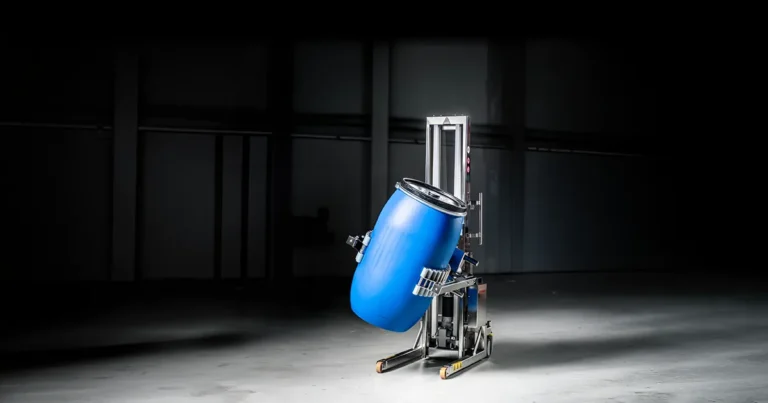
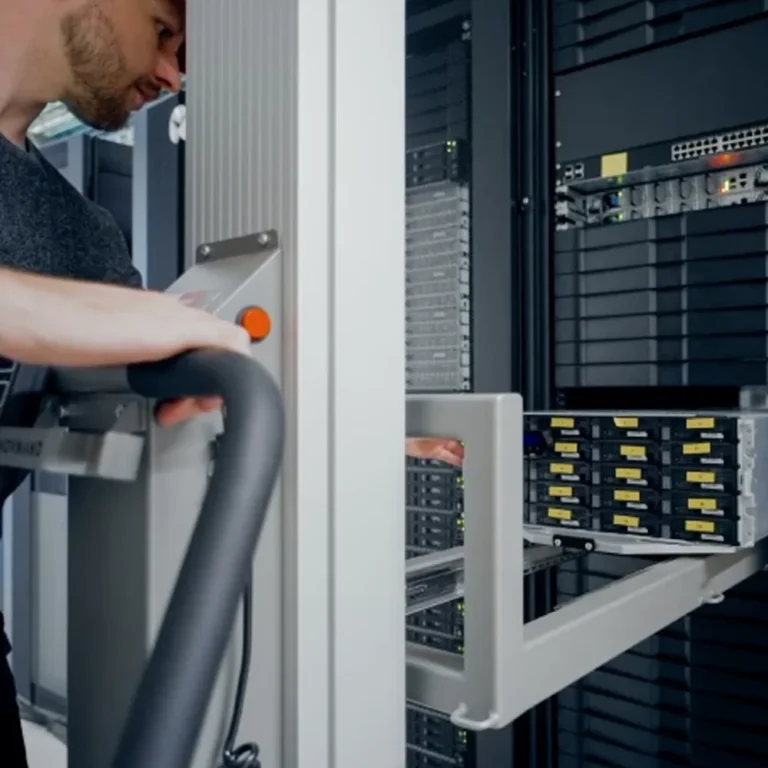
Imark Sistem offers Hovmand ergonomic electric lifts, for loads of up to 300 kg depending on the model and attachment, and ATIS pneumatic manipulators, with grippers designed for your product. For the end of the line we also have palletising solutions with collaborative robots. We come to see the post, choose the right gripper with you and, where possible, test with the real load.
Send us a photo of the load, its weight and a description of the movement. You can reach us at +40 21 255 71 74 or at office@imarke.ro. See all our handling systems.
Frequently asked questions about manual handling
What is the maximum weight an employee can lift?
EU and Romanian legislation do not set a single maximum weight; they require the employer to assess the risk. As a benchmark, the ISO 11228-1 standard uses 25 kg as the reference mass under ideal conditions; under real conditions, the acceptable limit is lower.
Which should I choose: an electric lift or a pneumatic manipulator?
A mobile electric lift suits you when you move loads between different points and lift them to height. A pneumatic manipulator suits you when the same movement is repeated at a fixed post. The load and the route decide.
Doesn’t the equipment slow the work down?
A lift with equipment can sometimes take a little longer than a manual one. In exchange, the pace stays the same throughout the shift and no longer depends on the operator’s fatigue. That is why a test at the real post matters.
Can the equipment work in areas with strict hygiene?
Yes, there are stainless steel versions and configurations for the food and pharmaceutical industries. Hygiene requirements are defined when the application is assessed.