A JAKA collaborative robot can take over palletizing and depalletizing of cases, shrink-wrapped packs or crates when the product weight plus the gripper stays within the robot’s payload and the line runs at a moderate rate. The application suits lines with many product codes and frequent format changes, where a conventional palletizer would take up too much space or sit idle.
In many plants the last station on the line is still a manual one: an operator lifts hundreds of cases per shift and stacks them on the pallet following a pattern learned on the job. Towards the end of the shift come fatigue, misplaced cases and unstable pallets. In this article we explain what a palletizing cell with JAKA collaborative robots looks like, which model to choose for your product weight, what changes in depalletizing and which other food industry operations a cobot can take on.

Why is palletizing a good application for a collaborative robot?
Palletizing is repetitive, physically demanding and follows a clear pattern: the same case, the same layout, layer after layer. That is exactly the kind of task a cobot handles well. JAKA describes the common situation in factories: manual palletizing costs time, puts a physical strain on employees and leads to errors, especially at the end of a shift.
Compared with a conventional palletizer, a cobot station has several practical advantages:
- Small footprint. The robot sits on a column fixed to a compact frame, next to the outfeed conveyor.
- It can serve several lines. The frame is moved with a pallet truck, so the same station can work on whichever line has orders that day.
- Easy to reconfigure. A new palletizing pattern is defined in the robot’s palletizing app through parameters (case size, layer pattern, number of layers), without conventional programming.
- It frees the operator for line feeding, quality control or pallet changes.
JAKA explicitly recommends mobile cobot stations for lines with lower utilization, frequent product changes and small-batch, multi-variant production. For lines dedicated to a single product at high throughput the reasoning changes; we come back to that case below.
What does a JAKA cobot palletizing cell look like?
A typical cell has the robot on a column, two pallet positions on either side, a fixed pick point for cases coming off the conveyor and a gripper suited to the packaging. JAKA offers a palletizing package (Cobot Palletizer Package), delivered together with certified integration partners, which can run stand-alone or integrated into the production line.
Technical data stated by the manufacturer for this package:
| Item | JAKA palletizing package |
|---|---|
| Robot | Fixed column with mounting plate for JAKA Pro 16 or JAKA Zu 20 |
| Arm reach | Up to 1,780 mm |
| Robot payload | 16 to 20 kg, depending on the model |
| Repeatability | ± 0.03 mm |
| Frame | Coated steel base moved with a pallet truck; adjustable feet for leveling |
| Pallets | Two pallet detection sensors, fixed zero point for both positions, reset button for each position |
| Operation | JAKA teach pendant or external touch screen, palletizing app |
The two pallet positions matter in practice. While the operator removes the full pallet and brings an empty one, the robot can carry on at the second position, if the cell is configured that way. The sensors confirm the pallet is present, and the fixed zero point makes sure the pattern restarts correctly after each change.

Which JAKA model should you choose for palletizing?
Choose the model by the total mass at the flange and by the maximum pallet height, not by the case weight. The robot’s payload includes the gripper, the vacuum hoses and any accessory mounted on the arm. For example, if the gripper weighs 4 kg, a 12 kg case already means 16 kg at the flange.
The JAKA models we usually consider for palletizing, with the data published by the manufacturer:
| Model | Payload | Reach | What the manufacturer says |
|---|---|---|---|
| JAKA Zu 12 | 12 kg | 1,327 mm | For heavy-duty tasks such as machine tending, palletizing and packing; a balance between payload and reach |
| JAKA Pro 16 | 16 kg | 1,713 mm | IP68 protection, for environments with dust, water or oil; compatible with the palletizing package |
| JAKA Zu 20 | 20 kg | 1,780 mm | IP65 protection; recommended for loading, unloading, palletizing and packing heavy and large workpieces |
| JAKA Zu 30 | 30 kg | 1,350 mm | IP65 protection, ± 0.05 mm repeatability; designed for heavy objects in limited space, including palletizing |
| JAKA Zu 35 | 35 kg | 2,000 mm | IP65 protection, ± 0.05 mm repeatability; for handling and palletizing with high payload and long reach |
Reach decides how high and how far the robot can stack. A EUR pallet measures 1,200 × 800 mm, and the far corner of the top layer is the critical point. The robot has to get there with the case correctly oriented, not just touch the point with the flange. That is why you should check every palletizing pattern against the real case dimensions before choosing the model.

Leave a margin between the total mass at the flange and the robot’s rated payload. At high speeds and sharp accelerations, a case at the limit can slip out of the gripper or limit the permitted arm speed.
What changes in depalletizing?
Depalletizing is the reverse operation: the robot takes cases or crates off the pallet and places them on a conveyor, a table or straight into a machine infeed. The motion is the same, but uncertainty increases. When palletizing, the robot knows where it placed each case. When depalletizing, it receives a pallet built by someone else, moved by forklift and sometimes shifted or deformed.
The points we check in a depalletizing application:
- The real position of the cases. If pallets always arrive with the same pattern and are placed in a guide, the robot can work on fixed coordinates. If layers are shifted or mixed, you need 3D vision.
- Slip sheets between layers. The robot can remove them with a gripper designed for sheets as well, or the operator removes them when changing the pallet.
- Stretch film and straps. These are usually removed by the operator before the pallet enters the cell.
- The condition of the packaging. Damp, deformed or stuck-together cases call for a different gripping force and picking strategy.
JAKA notes that palletizing stations can be combined with a 3D vision system for unordered applications, with cases of different types and sizes on the same pallet. The same principle allows depalletizing of mixed pallets.

Which gripper should you use for cases, packs, crates or bags?
The gripper (the end-of-arm tool) decides whether the application is stable. The robot can be sized correctly, but a grip that does not suit the packaging leads to dropped cases and stoppages. Choose the type of grip by the secondary packaging, not by the product inside:
| Packaging | Usual grip | What to check |
|---|---|---|
| Closed cardboard cases | Vacuum, with suction cups or foam | Cardboard porosity, tape on the gripping face, cases with flaps that open |
| Shrink-wrapped packs | Vacuum with foam or mechanical grip | Gaps between bottles or cans, tight or wrinkled film |
| Plastic crates and boxes | Mechanical grip, on handles or edges | Edge stiffness, empty crates nested inside each other |
| Bags of bulk product | Fork or clamp gripper | Product shifting inside the bag when lifted, bag shape after filling |
| Trays and punnets | Vacuum or fingers with a matching profile | Fragility, deformation when gripped, hygiene requirements |
For products with variable packaging, ask for a gripping test on real samples. A few cases from current production, including the poorest ones, tell you more than any datasheet.

How do operators work safely next to a palletizing cobot?
A cobot does not automatically make the application safe. Safety comes from the risk assessment of the whole cell: robot, gripper, case, speed, stacking height and the area the operator enters. Palletizing has specific risks: a case falling from height, a hand trapped between the arm and the column or pallet, an impact at high speed around the top layer.
Typical measures for a cobot palletizing cell:
- a safety laser scanner with zones: the robot slows down when the operator approaches and stops when the operator enters the pallet area;
- separate pallet positions, so the operator changes one pallet while the robot works on the other, outside the hazard zone;
- speed and workspace limits set in the robot controller;
- physical guards where the assessment shows they are needed.
Robot applications are designed to the ISO 10218-1 and ISO 10218-2 standards (requirements for robots and for robot cells) and to machinery legislation. From 20 January 2027, Regulation (EU) 2023/1230 on machinery applies, replacing Directive 2006/42/EC. Build the risk assessment into the project from the start, not at commissioning.
When is an industrial robot or a dedicated palletizer a better fit?
A cobot is not the answer for every end of line. When throughput is high, cases are heavy or several lines feed the same palletizing point, an industrial robot or a dedicated palletizer works faster and with more margin. The comparison below sums up the criteria we use in discussions with customers:
| Criterion | Cobot palletizing | Industrial robot or dedicated palletizer |
|---|---|---|
| Throughput | Moderate, one line | High, one or more lines |
| Mass at the flange | Up to the limit of the chosen model (for example 20 or 35 kg) | High loads, including full layers |
| Space | Compact, mobile frame | Fixed cell, usually fenced |
| Product changes | Frequent, set up in the app | Rare or planned |
| Moving between lines | Possible, with a pallet truck | Not practical |
| Investment and commissioning | Lower | Higher, justified by volume |
If you are not sure which column your line belongs in, we start from the data: cases per minute, the weight of the heaviest case, the number of palletizing patterns and the available space.
What data should you prepare for the palletizing review?
A sound review starts from the product and the workstation, not from the robot catalog. With the information below we can quickly tell whether the application is feasible with a JAKA cobot and which configuration makes sense:
- the dimensions and weight of each type of case, pack or crate;
- the number of product codes and palletizing patterns;
- the pallet type (EUR 1,200 × 800 mm, industrial 1,200 × 1,000 mm or other) and the maximum height of the loaded pallet;
- the line rate, in cases per minute, and the number of shifts;
- how cases reach the robot: conveyor, orientation, stop;
- the available space, with a sketch or photos of the area;
- a short video of the current workstation, with the operator at work.
Think also about what happens to the pallet after the robot. Pallet labeling, case and pallet marking and stretch wrapping are part of the same tertiary packaging flow. For moving full pallets to the warehouse, you can consider autonomous mobile robots (AMR).
What else can JAKA cobots do in the food industry?
Palletizing is only one of the applications. For food and beverage, JAKA lists packing, labeling, palletizing, material handling and line transfer. The reason is the same everywhere: labor costs are rising, product variants are multiplying and repetitive workstations are hard to staff. Below are the operations we see most often on lines in the food industry.

Packing into cases, trays and crates
The cobot picks packed products from the conveyor and places them into cases, trays or crates, following the pattern the customer requires. JAKA points out that these applications take less space than fully automatic packing machines and are more flexible, which makes them suitable for small and medium batches where people still do the work today. See also our secondary packaging equipment.
Carton erecting
A cobot can fold and erect cases directly in the packing line, removing one more manual workstation. For high volumes, a case erector and sealer remains the faster option; the cobot makes sense when formats change often.
Loading and unloading packaging machines
The cobot can feed trays into a traysealer or take products from the outfeed of a thermoforming machine or a flow-pack machine. It is the same machine tending logic JAKA describes for manufacturing: replace the simple manual loading and unloading operations before automating the whole workstation.
Labeling and code verification
With a label applicator or a camera mounted on the arm, the cobot can label products with a variable position or present the package to a reader to verify the batch and expiry date. For lines running at a steady rate, label applicators and food packaging coding systems mounted directly on the conveyor remain the core solution.
Sorting and vision-guided handling
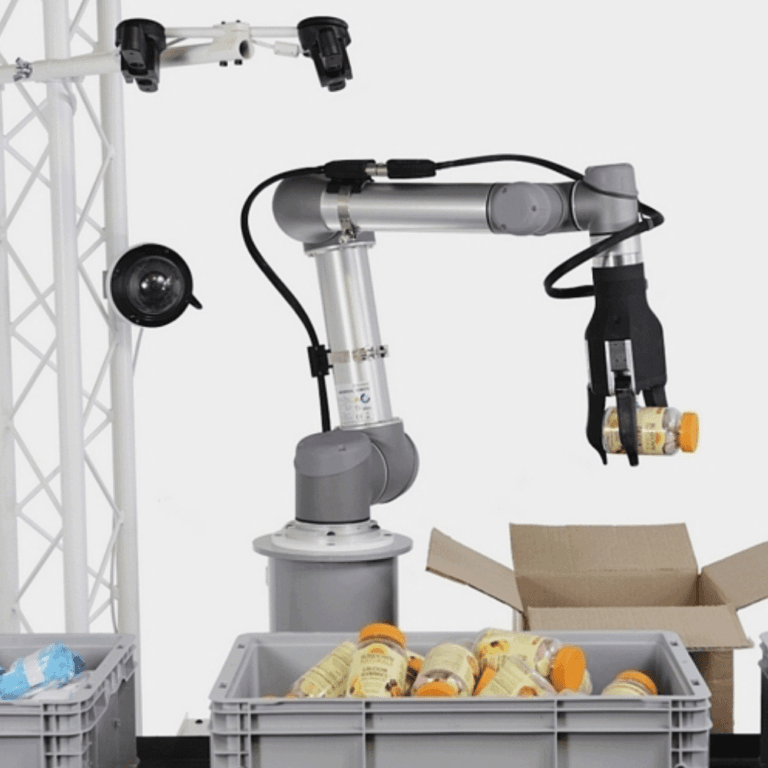
A cobot with a camera recognizes products of different types and sizes and picks them from random positions. The application fits sorting packages by variant, separating batches or feeding a line with products that arrive unordered.

Summary of food industry applications and the equipment they are usually integrated with:
| Application | What the cobot does | Equipment on the same line |
|---|---|---|
| Palletizing | Stacks cases, packs or crates on the pallet | Case and pallet marking, stretch wrapping, pallet labeling |
| Depalletizing | Unloads the pallet onto a conveyor or into a machine | Conveyors, 3D vision |
| Secondary packing | Places products into cases, trays or crates | Case erecting and sealing, checkweighers |
| Machine tending | Loads and unloads packaging machines | Traysealers, thermoforming, flow-pack |
| Labeling and verification | Applies labels, presents the code to a reader | Label applicators, coding systems |
| Sorting | Separates products by variant, using vision | Cameras, outfeed conveyors |
In areas with unpackaged product, check three things before choosing the robot: whether the gripper touches the food (the material must be approved for food contact), which cleaning agents and method you use, and what protection rating the arm needs. The JAKA Pro series has IP68 protection; for the other models, confirm the protection rating on the datasheet and, where needed, use a protective cover.
How does Imark Sistem help you automate the end of line?
Imark Sistem treats the JAKA cobot as part of a complete application. Depending on the project, the solution includes the robot, the gripper, the safety systems, the conveyors and the connection to the existing line. Because we have been working with coding, labeling and packaging for about 20 years, we look at palletizing in the context of the whole end of line: the code on the case has to be readable, the pallet label correct and the pallet stable for wrapping.
Send us the data from the list above or a video of the current workstation. Our team reviews the feasibility and comes back with the right configuration. You can reach us at +40 21 255 71 74 or at office@imarke.ro.
Frequently asked questions about palletizing with collaborative robots
How much weight can a JAKA cobot palletize?
It depends on the model. The JAKA range for palletizing goes from 12 kg (JAKA Zu 12) to 35 kg (JAKA Zu 35) payload. Subtract the weight of the gripper and accessories from that value; what remains, with a margin, is the maximum case weight.
Can a cobot work with two pallets?
Yes. The JAKA palletizing package has two pallet positions, each with a detection sensor and a reset button. The robot carries on at one position while the operator changes the full pallet at the other.
Can the palletizing station be moved from one line to another?
Yes, the station’s steel frame is moved with a pallet truck and has adjustable feet for leveling. After each move, check the position relative to the conveyor and the safety zones.
Can the same cobot also depalletize?
Yes, if pallets arrive with a known pattern and a repeatable position. For shifted pallets or different cases on the same layer, add a 3D vision system.
Does a cobot palletizing cell need a safety fence?
Not necessarily, but the risk assessment of the whole application decides. Many cells use laser scanners with slow-down and stop zones instead of a full fence; others need physical guards, depending on speed, stack height and case weight.
Can JAKA cobots be used in the food industry?
Yes, for packing, labeling, palletizing, handling and line transfer. In areas with unpackaged product, check the gripper material, the cleaning method and the robot’s protection rating; the JAKA Pro series is rated IP68.