
Autonomous mobile robots are changing the way warehouses work: instead of the operator walking the aisles, the goods come to the operator. In this article you will see which applications these robots cover, why their scalability matters, what Decathlon achieved in a warehouse automated with mobile robots, and what data to prepare if you want to evaluate such a solution for your warehouse or plant.
A technology manufacturer is deploying a new type of automation in warehouses around the world: autonomous mobile robots coordinated by software. You can find the current range of AMR autonomous mobile robots we offer on the dedicated page.
What are autonomous mobile robots and which applications do they cover?
Autonomous mobile robots (AMRs) are vehicles that move on their own through the warehouse or plant and carry out transport, picking or sorting missions, without physical paths marked on the floor. The manufacturer presented in this article describes its offering as one of the fastest-growing types of automation in the world for logistics companies.
Its technology offering is based on autonomous robots for 4 types of applications, all supported by an intelligent software platform based on artificial intelligence (AI):
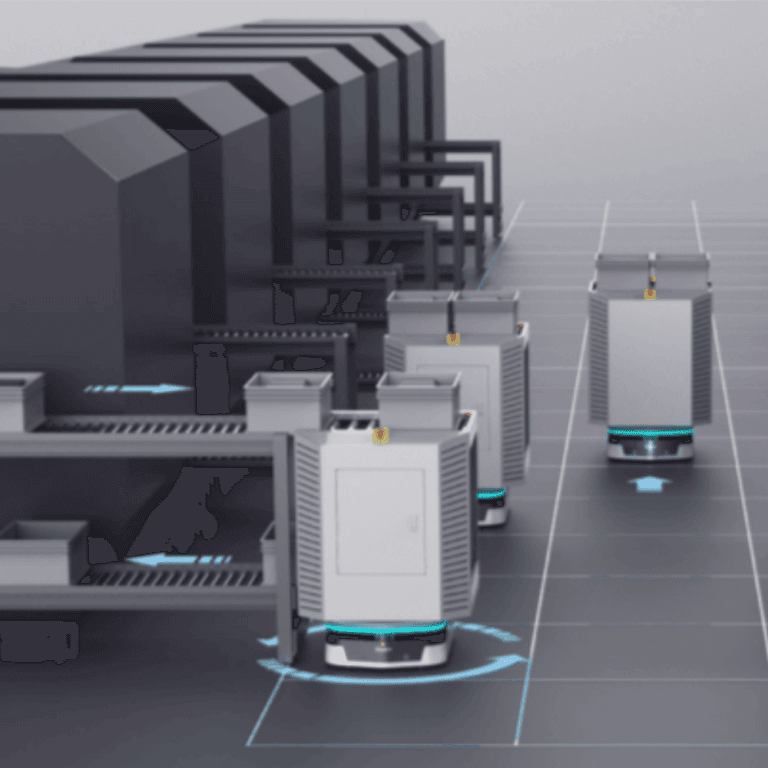
- picking: the robots bring the shelves with goods to the station where the operator works;
- moving: internal transport of goods between warehouse zones;
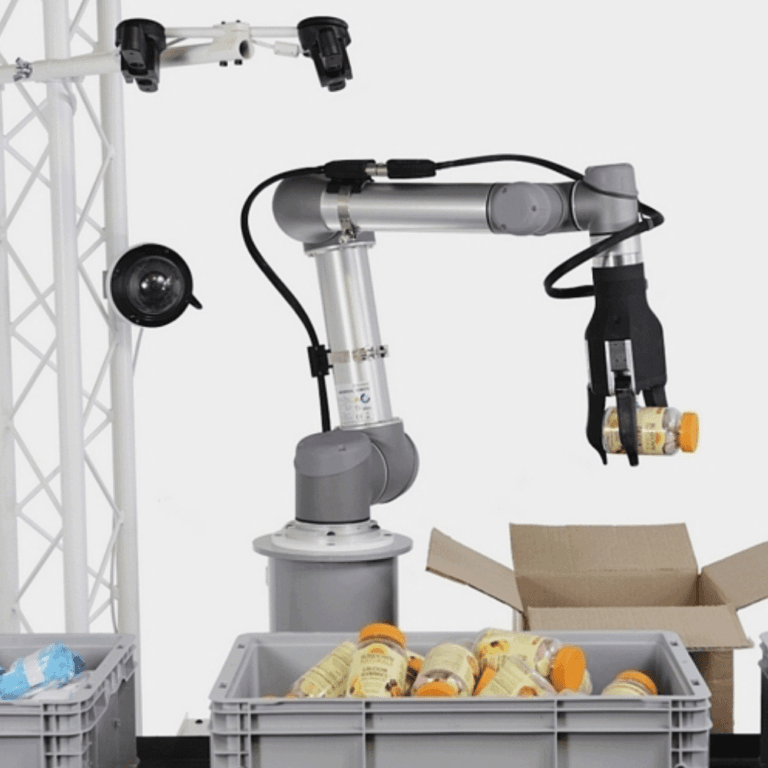
- forklift robots: picking up and transporting pallets instead of manually driven forklifts;
- sorting robots: distributing parcels or products to their destinations.
The software platform assigns missions, coordinates robot traffic and communicates with the warehouse management systems. For the user, the robot is the visible part; the software is what makes dozens of vehicles work together without getting stuck.
Why does scalability matter in logistics?
Scalability matters because volumes in logistics are not constant, while fixed automation is sized only once. You can therefore benefit from a scalable alternative to traditional fixed automation equipment, whether you are in e-commerce, logistics, an industrial customer or in manufacturing.
Perhaps one of the most notable features of this solution is its extreme scalability, both within a single logistics center and across a network of sites. A solution that can evolve in step with your business, whether it is growing rapidly or has to adapt to sudden increases or decreases caused by seasonal trends or unexpected crises.
In practice, with a mobile robot system, capacity grows by adding vehicles and stations, not by rebuilding the installation. A conveyor or a fixed automated storage system has a throughput set at the design stage; if the volume doubles, you need a new project. Conversely, if the volume drops, the robots can be moved to another zone or to another warehouse in the network.
What is “goods to person” picking?
“Goods to person” picking is the method in which the robot brings the shelf with the product to the operator’s station, instead of the operator walking to the product. The difference seems small, but it completely changes the working day in the warehouse.
In classic manual picking, a large part of the operator’s time is spent walking: from one shelf to another, with the order list in hand or on a terminal. In the “goods to person” approach, the operator stays at the station, and the system brings the shelves they need one by one and shows them which product to take and where to put it. The result is less walking, a steadier pace and fewer picking errors.
The method is particularly suited to warehouses with many product codes (SKUs) and small, frequent orders, such as those in e-commerce. For full-pallet flows between the warehouse and production, mobile robots for pallet transport are more commonly used.
Case study: what challenge did Decathlon face?
Decathlon needed to keep pace with the rapid growth in online orders, and its manual processes had reached their limit. The rapid growth of e-commerce at Decathlon highlighted the limited performance of manual processes. In addition, as a pioneer of RFID technology, Decathlon needed higher picking efficiency and accuracy to meet its business objectives.
About Decathlon
With more than 1500 stores in 49 countries, Decathlon is, according to the case study, the largest sporting goods retailer in the world. Founded in France in 1976, Decathlon is a professional specialist sporting goods retailer that integrates the entire production chain, from sports product design, research and development, manufacturing, branding and logistics to retail.
It is a situation many companies will recognize: the same warehouse has to serve both the stores, with large and predictable deliveries, and online customers, with small, numerous and urgent orders.
What solution was implemented in the Kunshan warehouse?
In the Kunshan warehouse, a “goods to person” picking application and an inventory solution were implemented, both based on RFID (radio frequency identification) technology. The manufacturer delivered innovative logistics solutions for this Decathlon warehouse.
The warehouse area is approximately 2,000 square meters, with 46 mobile robots, 7 picking stations and 7 single-point stations. The total warehouse stock is almost 300,000, involving more than 20,000 SKUs.
The combination of robots and RFID is the interesting part of the project. The robots handle the movement of goods, while RFID tags make it possible to identify products without scanning them one by one, which supports both picking accuracy and inventory. If you are interested in automatic product identification, see our Auto ID solutions.
What results did Decathlon achieve?
According to the case study, automation with mobile robots increased delivery capacity and picking efficiency and improved inventory management. The impact of automation at Decathlon:
- delivery capacity increased to 40,000 pieces/day;
- picking efficiency reached 300 pieces/hour, a 300% increase compared with manual picking;
- the picking system integrated with RFID technology improves inventory management and increases accuracy;
- the single-point station saves space and makes the operation more flexible.
These figures are those reported for this warehouse and this product mix. In another warehouse, the result depends on the number of codes, the order profile and how much of the operators’ time is currently lost walking.
What can you learn from this case for your warehouse?
The main lesson is that logistics automation can be done in stages, starting from the operation that limits you today. A few points to remember:
- Measure the manual process first. Without today’s figures (pieces per hour, errors, time lost walking) you cannot compare any quotation.
- Identify the bottleneck. At Decathlon it was picking for online orders; for you it may be pallet transport between the warehouse and production.
- Plan identification together with automation. The robot brings the goods, but the codes or RFID tags confirm that they are the right goods.
- Plan for peaks, not the average. The advantage of scalable solutions shows precisely in the high season or in times of crisis.
- Check integration with existing systems (WMS, ERP) from the quotation stage.
For an overview of warehouse solutions, from identification and weighing to palletizing and robots, see the page dedicated to the logistics industry.
AMR, AGV or fixed automation: how do you choose?
Choose according to how stable the flow is and how often it changes: fixed automation for large, constant flows, mobile robots for flows that vary or expand. The main differences:
| Solution | How it works | When it fits |
|---|---|---|
| Autonomous mobile robot (AMR) | Locates itself using the natural landmarks of the building, on a configured map, without tapes or reflectors along the route. | Changing flows, phased expansions, spaces also used by people. |
| Classic automated guided vehicle (AGV) | Usually follows a fixed route, defined by infrastructure or markings. | Stable routes that do not change often. |
| Fixed automation (conveyors, storage systems) | Installation sized for a given throughput and a given route. | Large, constant volumes on the same route over the long term. |
The solutions are not mutually exclusive. Many warehouses use conveyor belts on the main routes and mobile robots for the links that change.
What data should you prepare to evaluate a project?
Prepare data on loads, routes and pace. They are the starting point of the analysis, not eligibility conditions:
- the load transported: type, dimensions, maximum weight;
- pick-up and drop-off: from the floor, from a shelf, from a conveyor or from a station;
- the route: distances, aisle width, intersections, doors, ramps, lifts;
- the pace: number of transports or orders per hour and per shift, plus peaks;
- the environment: temperature, dust, humidity, floor condition;
- existing systems: WMS, ERP, automatic doors, scanners, the Wi-Fi network;
- traffic: the zones where people work or other vehicles move.
How does Imark Sistem help you?
We analyze your flow and propose the right solution: autonomous mobile robots for internal transport, integration with WMS or ERP, automatic identification and, where it makes sense, industrial or collaborative robots for palletizing. We handle the site analysis, commissioning, training and service. See all our robotic automation solutions.
Contact us at office@imarke.ro or on +40 21 255 71 74 for a customized solution.
Frequently asked questions about autonomous mobile robots in logistics
Which applications do autonomous mobile robots cover?
The solution presented covers 4 types of applications: picking, moving, forklift robots and sorting robots, all supported by an intelligent, AI-based software platform.
What does “goods to person” picking mean?
It is the method in which the robot brings the shelf with the product to the operator’s station, instead of the operator walking to the product. The operator walks less, and pace and accuracy increase.
What results did Decathlon achieve with mobile robots?
According to the case study, delivery capacity increased to 40,000 pieces/day, and picking efficiency reached 300 pieces/hour, a 300% increase compared with manual picking.
How does an AMR differ from an AGV?
A classic AGV usually follows a fixed route, defined by infrastructure or markings. An AMR locates itself using the natural landmarks of the building and navigates autonomously within the configured area.
Can robots be added along the way?
Yes. Scalability is one of the most important features of the solution: capacity grows by adding robots and stations, both within a single logistics center and across a network of sites.