
Automated conveyor belts (conveyors) connect the workstations in a factory and take over work that would otherwise be done by people and forklifts. In this article you will see what you gain when you automate internal transport, what types of conveyors exist and what each one suits, how to choose based on the product and how to prepare a transport project that fits your line.
For production facilities to evolve and become more efficient in this highly competitive economic landscape, key processes need to be automated. For manufacturers, smart transport technologies are part of this successful industrial automation mix.
What are the advantages of using automated conveyor belts?
Conveyors move products continuously, at the pace of the line, with fewer people and in less space. The advantages of using automated conveyor belts are:
- Space savings: automated conveyor belts need much less space than manually operated equipment (fewer operators, fewer forklifts); in addition, overhead conveyors can be used, which take up no floor space.
- Lower labor costs: conveyor belts require far fewer staff.
- Fewer human errors and fewer workplace accidents.
- Improved productivity.
There is one more effect, harder to see on paper: pace. A conveyor brings the product to the next station exactly when that station is ready, and an accumulation zone absorbs the short stops between machines. Without automated transport, these gaps are covered by people waiting or by stock placed on the floor next to the line. And in the aisles where forklifts no longer run, the risk of collisions with pedestrians also drops.
What types of conveyors are there?
The type of conveyor is chosen according to the product being transported: what its base looks like, how much it weighs and how stable it is. We implement solutions customized for your specific activity and flow, with the help of our specialized design and software departments. In short:
| Conveyor type | What it carries | Strengths |
|---|---|---|
| Roller | Boxes, crates, totes, cases with a rigid base | Accumulation, sorting, routes with curves and branches |
| Belt | Small, soft or irregular products, sacks, pouches | Continuous surface, inclines and declines |
| Chain | Bottles, jars, cans, heavy loads | Stable transport, tight curves with modular chain |
| Spiral | Boxes, totes, packaged products | Level change in a small footprint, product buffer |
| Pallet | Loaded pallets | End of line, link to stretch wrapping and the warehouse |
Roller conveyor systems


Roller conveyors are the usual choice for products with a flat, rigid base: cardboard boxes, crates, totes, cases. The rollers can be free (gravity), when the product runs down a slight slope, or motor-driven, when transport has to be controlled. With zoned motorized rollers you can achieve zero-pressure accumulation: products stop one behind the other without pushing each other. The practical rule is that there should always be at least three rollers under the product, otherwise small products tilt or jam.
Belt conveyor systems


Belt conveyors have a continuous surface, so they also carry what cannot travel on rollers: small, soft products with an irregular base, pouches, sacks or unpackaged products. A belt also allows inclines and declines; for steeper slopes, cleated belts or belts with better grip are used. In the food industry, belts suitable for food contact and modular plastic belts, which are easy to clean, are used. Control stations, such as checkweighers or metal detectors, usually also work on a belt.
Chain conveyor systems


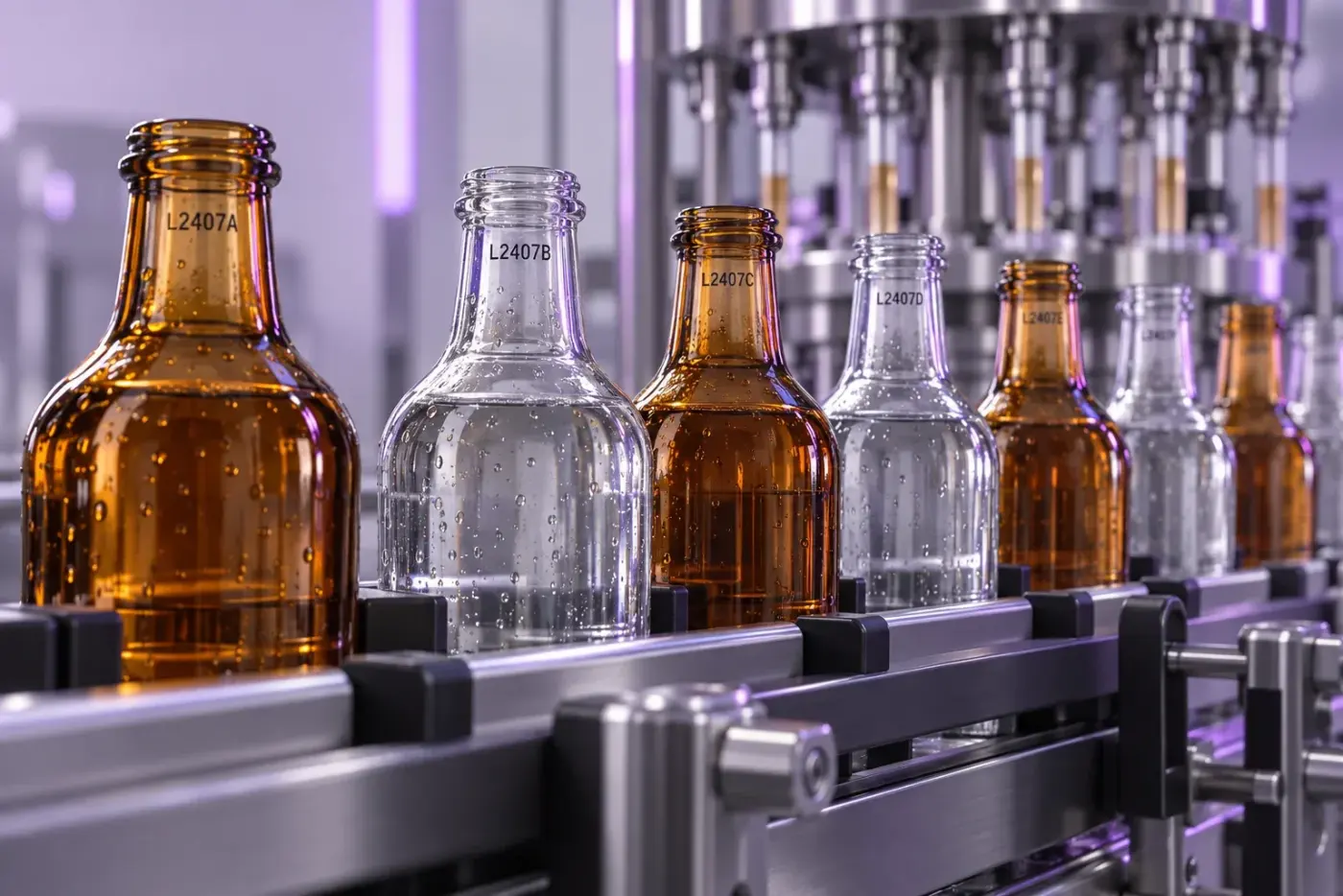
Chain conveyors carry the product on slats or on a modular plastic or metal chain. They are a classic in the beverage industry: bottles, jars and cans stand stably on the chain, and the flow can be combined or split into several lanes before the labeling or packaging machines. Modular chains can follow tight curves and long routes with few transfer points. Heavy-duty chain versions are also used for heavy loads, including pallets.
Spiral conveyors

A spiral conveyor moves products between levels in a small footprint: the product rises or descends on a helical track instead of a long slope. It is used to connect floors or mezzanines, to carry the flow over aisles and as a product buffer: the spiral holds a number of products on its track while the machine after it has a short stop.
Pallet handling conveyors

At the end of the line, pallet conveyors, with rollers or chain, take the loaded pallet and carry it through the following stations: stretch wrapping, labeling, buffer storage until it is picked up by forklift. They are built for heavy loads, run at low speeds and stop the pallet precisely in front of each station. This is usually also where the automatic stretch wrapper is connected, for which you will find a separate guide: how to choose a pallet wrapper.
How do you choose the conveyor type based on the product?
Start from the product and the pace, not from the catalog. Answer a few questions:
- What dimensions and weights do the products have, from the smallest to the largest? What does their base look like: flat, rigid, soft, with edges?
- How stable is the product? Empty bottles or tall packs can tip over at stops and transfers.
- How many products per minute must be transported now, and how many in the coming years?
- Do you need accumulation between machines, and how long must it cover?
- Where does the level change: inclines, declines, crossings over aisles?
- In what environment does the conveyor work: washdown, cold, humidity, dust? What hygiene requirements do you have?
- What operations take place along the route: marking, labeling, weighing, inspection, sorting?
The answers usually lead you to a combination: rollers for boxes, belt at the control stations, chain for bottles, spirals where space is short. A good route uses the right type on each section and has as few transfers as possible between conveyors of different types.
What mistakes are common in internal transport?
Most problems occur at the connections between pieces of equipment, not on the conveyor itself:
- Neglected transfers. A gap remains between two conveyors where small products catch or fall.
- Too little accumulation. Without a buffer zone, any short stop of one machine stops everything upstream of it.
- Future formats forgotten. A conveyor sized strictly for today’s product will not take tomorrow’s larger box.
- Difficult access for cleaning and maintenance. Cramped routes are hard to clean, and maintenance gets postponed.
- Safety left to the end. Guards, emergency stop buttons and walkways for people must be planned from the design stage.
- Separate controls. The conveyor must receive a signal when the next machine is stopped, otherwise it pushes products into a station that can no longer take them.
How does the conveyor connect to the rest of the line?
The conveyor is the thread that joins the stations of the line, so it is designed together with them. Along the same route you will usually install:
- marking printers and labeling systems for boxes, multipacks and pallets;
- checkweighers, metal detectors or product inspection systems;
- secondary and tertiary packaging equipment: case forming and sealing, pallet stretch wrapping;
- autonomous mobile robots (AMR), which pick up pallets or totes from the end of the conveyor.
The control side matters as much as the mechanical side: sensors, stops and signals between machines decide whether the line runs smoothly. That is why our design and software departments work together on such projects. Our partners include FlexLink, with modular chain and belt conveyors, and Interroll, with solutions for roller conveyors: rollers, drum motors, conveyor modules and sorting systems.
How do you prepare an automated transport project?

A good transport project starts from a sketch of the hall and the list of products. Prepare:
- a sketch of the space, with the existing machines, columns, doors, aisles and available height;
- the list of products, with dimensions, weights and photos, including the formats you are planning;
- the pace: products per minute now and the target for the coming years;
- the start and end points and the operations along the route (marking, weighing, labeling, palletizing);
- environmental and hygiene requirements: washdown, cold, clean zones;
- a short video of today’s flow, especially of the places where products pile up.
With this data we can propose the route, the conveyor types and the accumulation zones, and estimate what you gain in space and staff.
How does Imark Sistem help you?
Transport automation solutions, customized for your industry: we design automated transport solutions for production flows that increase efficiency in a wide range of industries (food and beverage, personal care products, healthcare, automotive and electronics, logistics, etc.). Based on our extensive experience (more than 15 years) and on solutions developed with proven efficiency, we will make sure that the proposed solutions maximize the operational performance of your lines.
In practice, we analyze the flow and the products, propose the route and the conveyor types, handle installation, commissioning and training, and provide service and spare parts. See also our other industrial handling systems. You can reach us at +40 21 255 71 74 or at office@imarke.ro.
Frequently asked questions about conveyors
What type of conveyor is suitable for cardboard boxes?
Usually a roller conveyor, motorized or gravity. Boxes have a flat, rigid base, and rollers allow accumulation, curves and branches. For very small or soft boxes, a belt may be more suitable.
Which conveyor is used for bottles and jars?
The chain conveyor, with slats or modular chain, on which containers stand stably and can be combined or split into several lanes before the labeling or packaging machines.
What do you do when you have no floor space?
Use overhead conveyors, which take up no floor space, or a spiral conveyor, which moves products between levels in a small footprint.
Can conveyors be added to an existing line?
Yes. We start from the sketch of the hall and the existing machines and design the route and the controls so that the conveyors work at their pace. Tell us from the start about any changes you are planning as well.
What exactly do you gain with automated conveyor belts?
Space savings, lower labor costs, fewer human errors, fewer workplace accidents and improved productivity.