


The IFS Food standard is recognized internationally and concerns the quality and safety of food products. Compliance with the specific IFS Food requirements can be ensured with professional metal detection or X-ray equipment, but the auditor does not look only at the equipment: they want to see how you chose it, how you test it and what you do with rejected product. In this guide you will find out what IFS Food requires regarding metal foreign bodies, how to prepare your detector and documents for the audit and how CEIA detectors help you.
What is the IFS Food standard and what does it aim for?
IFS Food is the standard against which food manufacturers supplying retail are audited, especially in Europe. It is based on the general aspects of a food safety management system. The main role of this standard is to build trust in products and processes. It applies when products are processed or when there is a risk of product contamination during packaging, and it matters especially for private label manufacturers (store brands).
The version in force is IFS Food version 8, published in April 2023 and mandatory for audits from 1 January 2024. The standard has a few requirements called KO (knock-out): if the auditor finds a KO nonconformity, certification cannot be granted. Two of these requirements concern you directly when you use a metal detector: the one on foreign bodies and the one on monitoring critical control points. We take them one by one below.
What does IFS Food require regarding metal contamination?
IFS Food requires that, based on risk analysis, you have documented, implemented and maintained procedures that prevent contamination with foreign bodies, and that contaminated products are treated as nonconforming. This is requirement 4.12.1, one of the KO requirements. For detectors, the standard adds a few concrete conditions:
- Effective installation. Where metal or other foreign body detectors are needed, they are installed so that detection is as effective as possible.
- Maintenance. Detectors undergo maintenance at least once every 12 months or whenever significant changes occur.
- Specified accuracy and functional tests. The accuracy of the equipment must be specified, and its operation is tested at a frequency based on risk.
- Assessment of failures. If the detector fails or does not pass a test, assess the impact on products and processes.
- Isolation of suspect products. Potentially contaminated products are isolated, and only authorized personnel have access to them.
In short: the standard requires control of physical hazards, not a specific piece of equipment. The metal detector is the concrete way you demonstrate to the auditor that the risk is covered and documented.
Is the metal detector a critical control point (CCP)?
You make that decision in the plant’s HACCP analysis, and it determines how much documentation the auditor asks of you. If the detector is established as a critical control point (CCP), it falls under the KO requirement on CCP monitoring: you need a monitoring procedure with method, frequency and recording of results, and each CCP must be under control. Records are checked by a responsible person in the company and kept for a relevant period. The operators who carry out monitoring must be specifically trained for it.
If the detector is not a CCP, you do not escape the paperwork. The IFS audit report lists the equipment and methods used against foreign bodies, with their place in the flow, and for detectors that are not CCPs, the test samples used and their sizes: ferrous, non-ferrous metals, stainless steel. If you have no detection equipment at all, the auditor wants to see what other measures you have taken.
Where to install detectors in the flow (at raw material, at finished product or at both points) is explained in the article on metal detectors that protect your consumer and your brand.
How do you choose test samples and sensitivity?
Use the smallest test samples that the detector reliably finds on your product, separately for ferrous, non-ferrous metals and stainless steel. The IFS guideline on foreign body management recommends samples as small as possible, to cover the widest possible range of contaminants, and asks you to take customer specifications into account. Samples must be intact; if in doubt, replace them.
Where the sample passes also matters. A detector’s sensitivity is lowest at the center of the aperture, which is why the sample is passed together with the product, through the center. This also gives a simple rule when choosing the equipment: an aperture that is too large for the product reduces sensitivity.
The product itself gives a signal (product effect), which depends on moisture, salt content, temperature, size and packaging. A moist, salty or frozen product requires a different setting than a dry one. With every product change you also change the detector program; CEIA detectors store settings for up to 500 products, and the product can also be selected via a barcode reader, so it does not depend on the operator’s memory.
How often do you test the detector and what do you do if the test fails?
IFS Food does not set a frequency: you set it yourself, based on risk, and justify it in the risk analysis. In many plants, the test is done at line start-up, at every product change, at fixed intervals during the shift and at the end, but the right frequency for you depends on product, volume and customer requirements.
More important than the frequency is what you do when the test fails. The standard requires you to assess the impact on products. In practice, this means blocking everything produced since the last successful test, reinspecting those products after the detector has been repaired and adjusted, and recording everything: the time, the cause, the quantity blocked, the decision taken and who took it. The less often you test, the larger the quantity of product you have to block when a test fails.
For routine maintenance and post-installation checks you will find more details in the guide on metal detectors in the food industry.
How do you prove that contaminated product is actually removed?
By checking the entire rejection process, not just the detector. A detector that signals correctly does not help you if the pusher does not act or if the bin for rejected products is full. The IFS guideline draws attention to exactly these situations and recommends frequent checks of the reject device, the bin and the control sensors.
- Reject confirmation: the system checks whether the contaminated product was actually removed.
- Reject bin: a sensor checks whether the bin is in place and whether it still has room.
- Conveyor speed: at speeds that are too high or too low, detection accuracy is no longer guaranteed; follow the manufacturer’s specifications, especially on lines with frequent starts and stops.
- Controlled access: the bin with rejected products is kept locked, and the products are analyzed only by authorized personnel.
What do CEIA THS metal detectors bring to the audit?
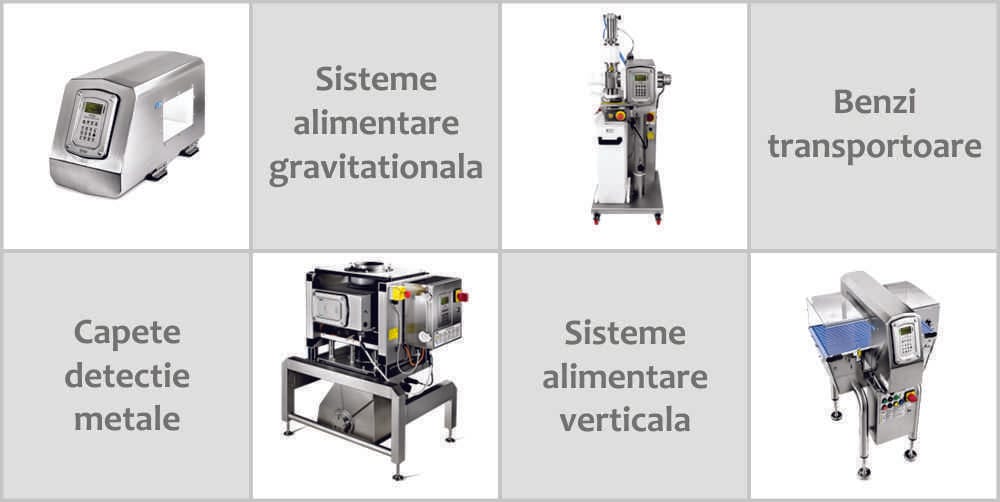
CEIA THS metal detectors are high-performance equipment, incorporating state-of-the-art technology, that detect metal contaminants accidentally present in food products. They offer high sensitivity levels, immunity to environmental interference and response speeds designed to meet the most demanding applications. The detected contaminants can be metallic (magnetic, non-magnetic) or stainless steel.
The innovative Multi-Spectrum technology, patented by our partners at CEIA, automatically selects and simultaneously uses a set of detection frequencies adapted to both the product and its packaging, for maximum compensation of the interference created by the product and its packaging. Under certain conditions, this allows the detection of contaminants in difficult products and/or in products packed in metallized film. HACCP and GMP compliant, CEIA metal detectors are ISO 9001 certified and built from CE and FDA approved materials.
For the audit file, the recording functions matter: CEIA detectors log events (rejects, test results, access and programming changes, faults), have password-protected user access, signal when a test is due and check the reject and the reject bin. With the THS Production 4.0 software, checks and data can be archived centrally. You will find the technical details in the article 7 reasons to use CEIA MultiSpectrum metal detectors.
What documents do you prepare for the IFS audit?
Prepare a file that links the risk analysis to what happens daily on the line. A starting list:
- The risk analysis for foreign bodies and the HACCP decision: whether the detector is a CCP or not, and why.
- The list of detection equipment, with the place of each in the flow.
- The established sensitivity for each product or product group, with the test sample sizes for ferrous, non-ferrous and stainless steel.
- The test procedure: frequency, who tests, how the sample is passed, what is done when a test fails.
- Test records, signed and checked by a responsible person.
- The procedure for rejected products: isolation, who has access, how they are analyzed and how their fate is decided.
- Maintenance records, with the annual service and those carried out after significant changes.
- Training evidence for the operators who carry out the tests.
If your product also has other physical risks (glass, stone, bone), assess whether the metal detector is enough or whether you need an X-ray system; the guide metal detector or X-ray inspection will help you.
How does Imark Sistem help you?
As the official CEIA partner in Romania, we help you commission a detection system you can defend in front of the auditor. We analyze the line and the products, test detection on your samples, establish the configuration together (on a conveyor, in free fall or in a pipeline), install, set up the products and train the operators for testing. After commissioning we provide service and periodic maintenance, with nationwide coverage.
See the range of CEIA metal detectors or write to us about your products and the requirements your customer has sent you. You can reach us at +40 21 255 71 74 or at office@imarke.ro.
Frequently asked questions about IFS Food and metal detection
Is a metal detector mandatory for IFS Food certification?
Not as a specific piece of equipment. IFS Food requires that, based on risk analysis, you prevent contamination with foreign bodies. In most food plants, the metal detector or the X-ray system is the way you demonstrate that this risk is controlled.
How often must the metal detector be tested?
The standard requires functional tests at a frequency based on risk, which you justify in your documentation. Often, the test is done at start-up, at product change, periodically during the shift and at the end.
Which test samples do I use?
Separate samples for ferrous, non-ferrous metals and stainless steel, as small as possible but reliably detected on your product, also taking customer specifications into account. The sample is passed through the center of the aperture, where sensitivity is lowest.
What do I do with products made before a failed test?
You block them and treat them as potentially contaminated: everything produced since the last successful test is isolated and reinspected after the detector is repaired. The assessment and the decision are recorded.
How often must the detector be maintained?
IFS Food version 8 requires detector maintenance at least once every 12 months or whenever significant changes occur, to avoid malfunctions.