

2D codes and traceability solutions for production and packaging
Dynamic 2D codes (generated directly on the production line and containing variable data for each batch or product) are becoming the new standard for product identification and traceability in industry, logistics and retail. They make it possible to include far more dynamic information than traditional barcodes and give companies the ability to link physical products to digital data from production and supply chain systems.
The GS1 organisation is driving the global transition from 1D codes (EAN / UPC) to 2D codes through the GS1 Sunrise 2027 initiative, which aims to move to 2D codes by 2027.
By implementing 2D codes, manufacturers can improve product traceability, reduce waste in the logistics chain and give consumers access to detailed product information.
GS1 Sunrise 2027 is a global, industry-led initiative that aims to move from traditional 1D barcodes (EAN / UPC) to 2D codes (QR Code or DataMatrix) by 2027.
This transition allows companies to include more information in the codes printed on products and packaging, improving supply chain traceability and giving consumers access to additional information.
GS1 Sunrise 2027 is not a European regulation or a law, but an objective adopted globally by industry, supported by manufacturers, retailers and the GS1 organisation.
What are 2D codes?
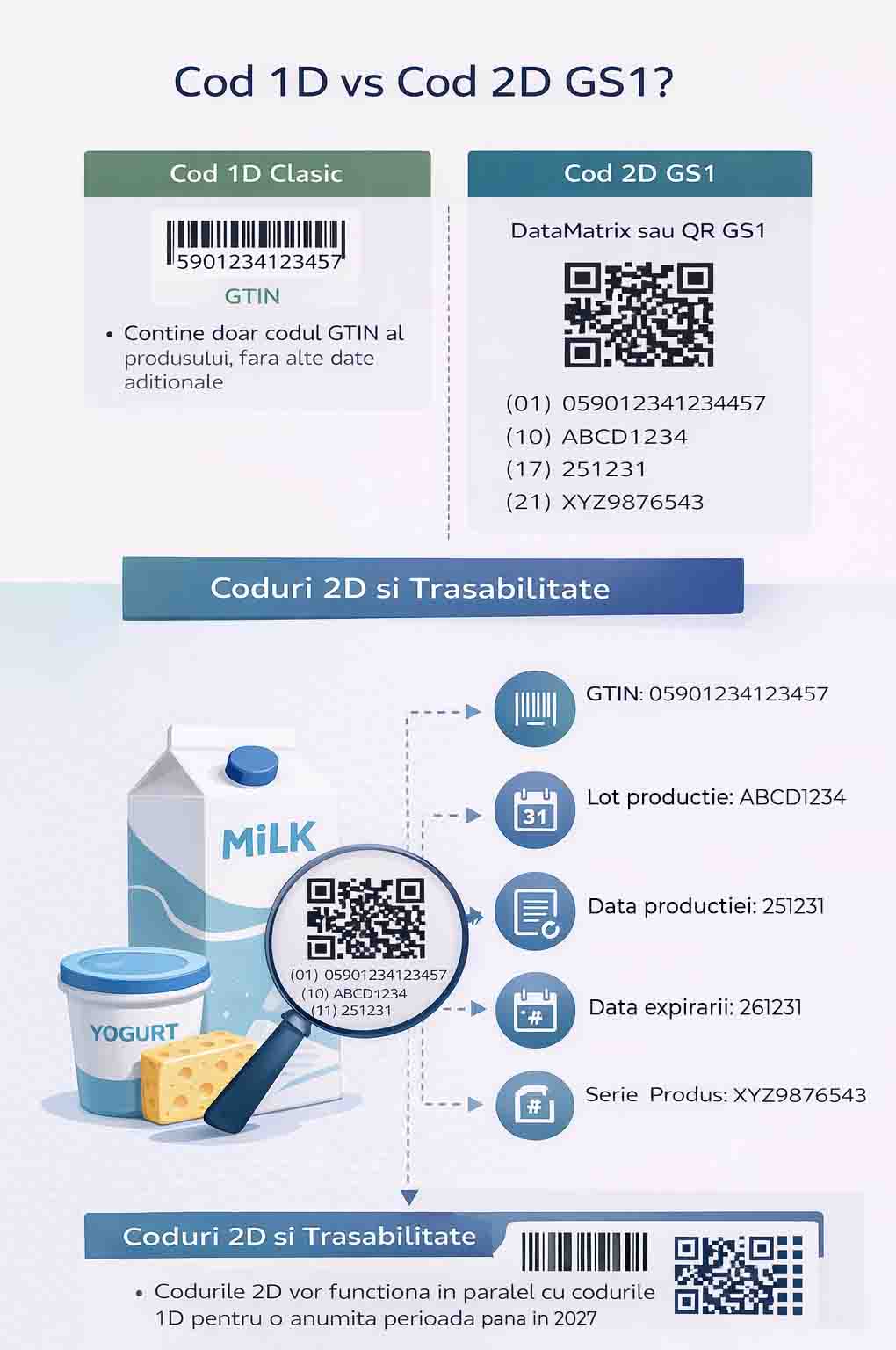
2D codes, such as QR and DataMatrix, are two-dimensional codes that can store far more information directly on the product or packaging than classic barcodes (EAN / GTIN for products or GS1-128 for logistics):
- GTIN product code
- production batch
- expiry date
- unique product serial number
- logistics data
- consumer information
A single 2D code can replace several items of information printed on the packaging and can connect the product with digital systems in production, logistics and retail.
Advantages of 2D barcodes
- Encoding a large amount of data in a small code, including numbers, all character types, binary data, control codes, etc.
- Can be printed in a very small area. 2D codes use roughly 10 times less space than a traditional 1D barcode.
- Can be read regardless of the scanning angle, including at high scanning speeds.
- Fast recovery when unexpected problems occur and improved operational efficiency (OEE).
- Resistance to dirt and damage. 2D codes include error correction, and data can be recovered even if part of the code is smudged or damaged.
Why are 2D codes becoming the new standard?
The industry faces several challenges that are driving the adoption of 2D codes:
- growing product traceability requirements
- increasingly strict food safety regulations
- transparency demands from consumers
- a growing number of products and packaging variants
- digitalisation of the supply chain
2D codes allow companies to manage these challenges by including detailed information directly on the product packaging.
The global transition to GS1 2D codes – GS1 Sunrise 2027 – is already under way. By 2027, dynamic and enhanced QR codes will replace traditional barcodes as the industry standard. During the transition period, products will carry both the classic EAN barcode and an additional 2D code.
Implementing 2D codes brings clear benefits:
Complete product traceability: 2D codes can include information on batch, expiry date or product serial number, allowing products to be tracked throughout the logistics chain.
Brand protection: Unique codes make it possible to verify product authenticity and reduce the risk of counterfeiting.
Stock management: 2D codes can help manage inventory and apply the FIFO (first in, first out) principle.
Waste reduction: By tracking products and managing inventory efficiently, product waste and logistics costs can be reduced.
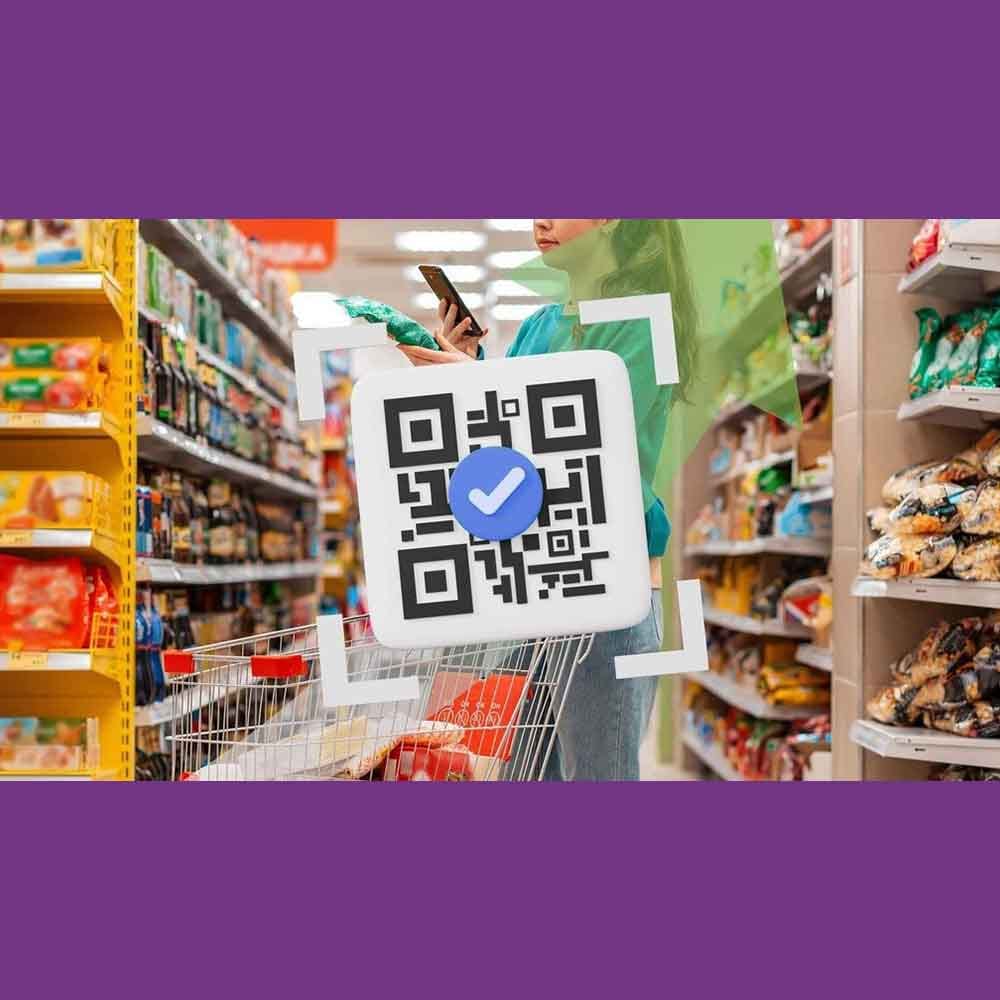
Consumer engagement: By using QR codes, manufacturers can give access to product information, recipes, instructions or promotions.
The sooner you start, the more time you have for optimisation, pilot testing and scaling.
What is GS1 Digital Link?
GS1 Digital Link is an extension of GS1 codes that turns the code on the product into a digital link. In practice, the 2D code printed on the packaging can direct the user, by scanning it with a smartphone, to online product information (product information, instructions for use, recycling information, promotions or marketing campaigns, product authenticity verification, etc.).
GS1 Digital Link is not mandatory, but it is increasingly used to connect physical products with digital platforms and will become the standard of the future in retail, industry and logistics.
Where are 2D codes used?
2D codes can be printed directly on:
Primary packaging: pouches, films, bottles, cans, trays, etc.
Secondary packaging: cardboard boxes, cases, logistics labels, etc.
Individual products: industrial parts, components, electronics, etc.
Pallets and logistics units: for tracking in the warehouse and in distribution
Examples of 2D code use
2D codes can be used in numerous production and retail scenarios.
Product traceability
- identification of production batches
- management of product recalls
- quality control
Logistics and warehousing
- identification of boxes and pallets
- inventory monitoring
- optimisation of logistics flows
Brand protection
- verification of product authenticity
- detection of counterfeit products
Consumer experience
- product information
- instructions for use
- promotions and marketing campaigns

Solutions for implementing 2D codes
Markem-Imaje is one of the global leaders in product identification and traceability solutions. As a partner for Romania, the Imark Sistem portfolio of solutions from Markem-Imaje includes:
- 2D code printing systems
- software for data management and print message management
- solutions for code quality verification
- integration with ERP, MES and WMS systems
These solutions allow companies to implement complete product traceability and identification projects.
To implement dynamic 2D codes on packaging, we offer several industrial marking technologies :
- industrial inkjet printers (CIJ)
- thermal transfer printers (TTO)
- laser printers
- print & apply systems for labelling, and Large Characters and Valvejet printers
The choice of technology depends on:
- the packaging material
- the production line speed
- the code size
- the type of information printed
Experts in 2D barcode solutions for the production line
Imark Sistem helps brands and retailers harness the power of 2D codes and the potential of dynamic data at company and product level, to meet the demands of a complex market and succeed in a constantly changing world.
We believe that interconnected digital data holds the key to the future of supply chain and retail management, consumer engagement and regulatory compliance. We have the solutions and expertise to make the transition to a higher standard as simple and efficient as possible.
Challenges we solve for brands and retailers
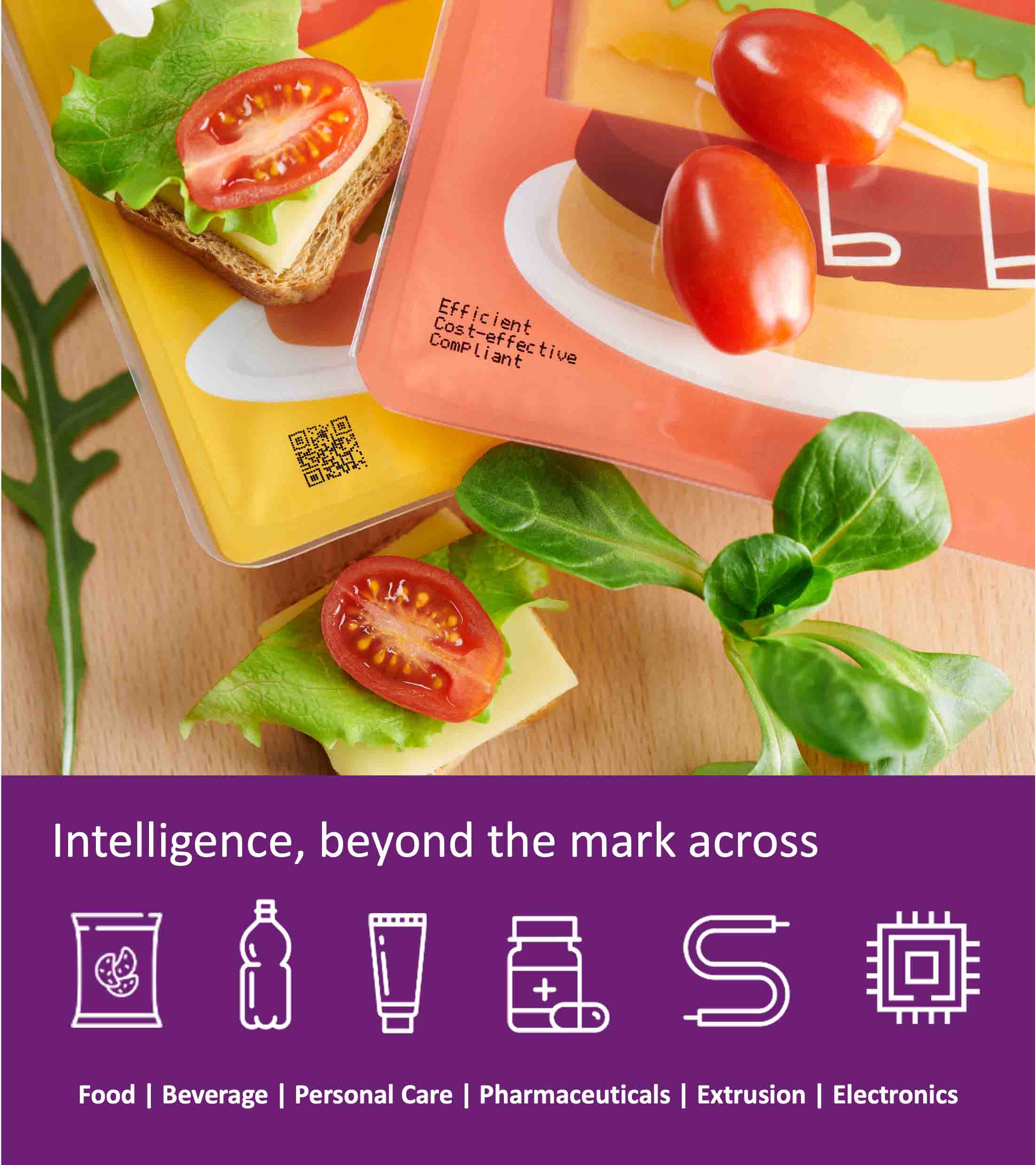
Efficient inline printing of compliant, dynamic, information-rich 2D codes, on almost any type of substrate and shape, from low speeds to high speeds
Seamless management and connection of company-level data and its integration into 2D barcodes
Creation of unique 2D codes for traceability, supply chain visibility and brand protection
Improved consumer interaction and engagement through QR codes.

Why choose Imark Sistem?
Imark Sistem is an official Markem-Imaje partner in Romania and offers full support for implementing marking and traceability solutions.
Customers benefit from:
- consultancy for implementing dynamic 2D codes
- integration of equipment on the production line
- installation and configuration of marking systems
- local service and technical support nationwide
- supply of original consumables
Request consultancy for implementing dynamic 2D codes!
If you want to implement dynamic 2D codes for product traceability or for compliance with GS1 standards, the Imark Sistem specialists can help you choose the right solution for your application.
Contact the Imark Sistem team for an application analysis and for the implementation of a complete marking and traceability solution.
Q&A Frequently asked questions about 2D codes
What is the difference between static 2D codes generated online and dynamic 2D codes used in production?
Static 2D codes are usually generated on online platforms and contain fixed information that does not change after generation. For example, a QR code can point to a website or a product page.
2D codes used in production are dynamic codes generated directly on the production line and containing variable data for each batch or product, such as GTIN, batch number, expiry date or serial number. These codes are integrated with the company’s IT systems and enable product traceability throughout the logistics chain.
How can I implement 2D codes on my production line?
Implementing 2D codes on a production line involves several stages, depending on the packaging type, line speed and traceability requirements.
In general, the process includes:
- choosing the type of 2D code (GS1 DataMatrix or GS1 QR)
- defining the information to be included in the code (GTIN, batch, expiry date, product serial number, etc.)
- choosing the printing technology suited to the packaging
- integrating the marking system with the company’s IT systems (ERP, MES or WMS)
- verifying code quality to ensure correct reading in production, logistics and retail
Depending on the application, 2D codes can be printed directly on the packaging or applied via labels printed automatically on the production line.
The Imark Sistem specialists can analyse your application and recommend the right solution for implementing 2D codes and traceability systems on your production line.
What types of 2D codes are used in industry?
The most widely used types of 2D codes in production are:
GS1 DataMatrix – frequently used for industrial traceability
GS1 QR Code – used for retail applications and consumer engagement
GS1 Digital Link – QR codes that connect the product with online information
The choice of code type depends on the application, the space available on the packaging and the supply chain requirements.
Can 2D codes be read by existing retail scanners?
Currently, most retail scanners are optimised for 1D codes. That is why, during the transition to the GS1 Sunrise 2027 standards, products will usually carry both the classic barcode and a 2D code.
Modern retail scanners have already been updated to read 2D codes at the point of sale. We also offer a wide range of scanners suitable for reading 2D codes.
Is it mandatory to use 2D codes on products?
At present, no regulation makes the use of 2D codes mandatory. However, the retail industry and the GS1 organisation are promoting their adoption to improve product traceability and to enable 2D code scanning at the point of sale by 2027.
For this reason, many manufacturers are already starting to implement these codes on packaging.
Can 2D codes be integrated with the company’s IT systems?
Yes. In industrial applications, 2D codes are generated using data from company systems such as ERP, MES or WMS.
This enables:
- automatic generation of codes for each batch
- tracking of products in the warehouse and in logistics
- collection of production data
- complete product traceability.
Request consultancy for implementing 2D codes
Call us on 021 255 71 74
Fast response · free consultancy · dedicated technical support