
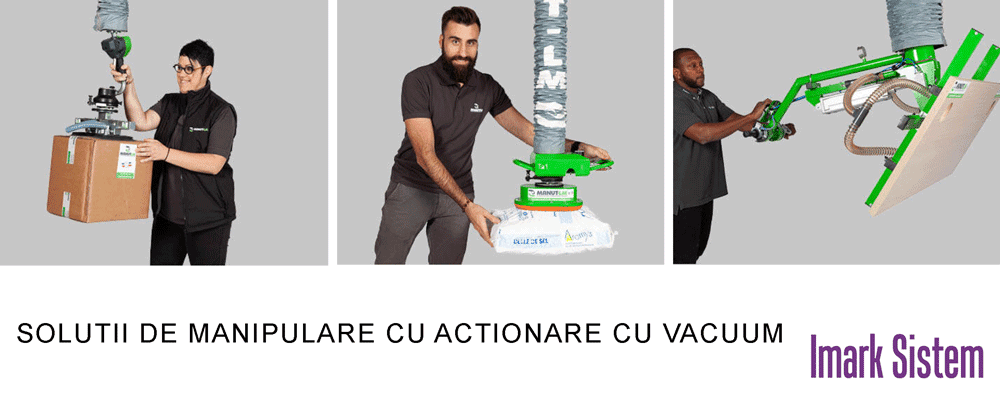
A vacuum-operated manipulator grips the load with a suction cup and makes it almost weightless for the operator. In this article you will see what loads you can lift this way, how the equipment works, how the gripping head is chosen, when vacuum is the right choice and when it is not, plus what data to prepare for a quote.
What loads can you handle with vacuum?

Almost any load with a surface on which a suction cup can sit. Do you need to handle boxes of different sizes, up to 250 kg? Or any other loads: sacks, boxes, panels, drums and containers, trays, food products, non-standard loads, empty pallets, beams, boards, glass sheets, doors?
Our vacuum-operated manipulators let you handle these loads without strain and in complete safety. What these loads have in common is that they are lifted often, from a pallet, a conveyor or a stack, and carried to a workstation, to a machine or back onto a pallet. It is exactly these repetitive movements that tire and injure operators.
Typical examples from factories and warehouses:
- palletizing and depalletizing sacks of flour, sugar, granules or fertilizer;
- feeding a line with cardboard boxes taken from a pallet;
- handling panels, boards and doors in furniture and joinery factories;
- moving glass sheets in production or during assembly;
- lifting closed drums and containers;
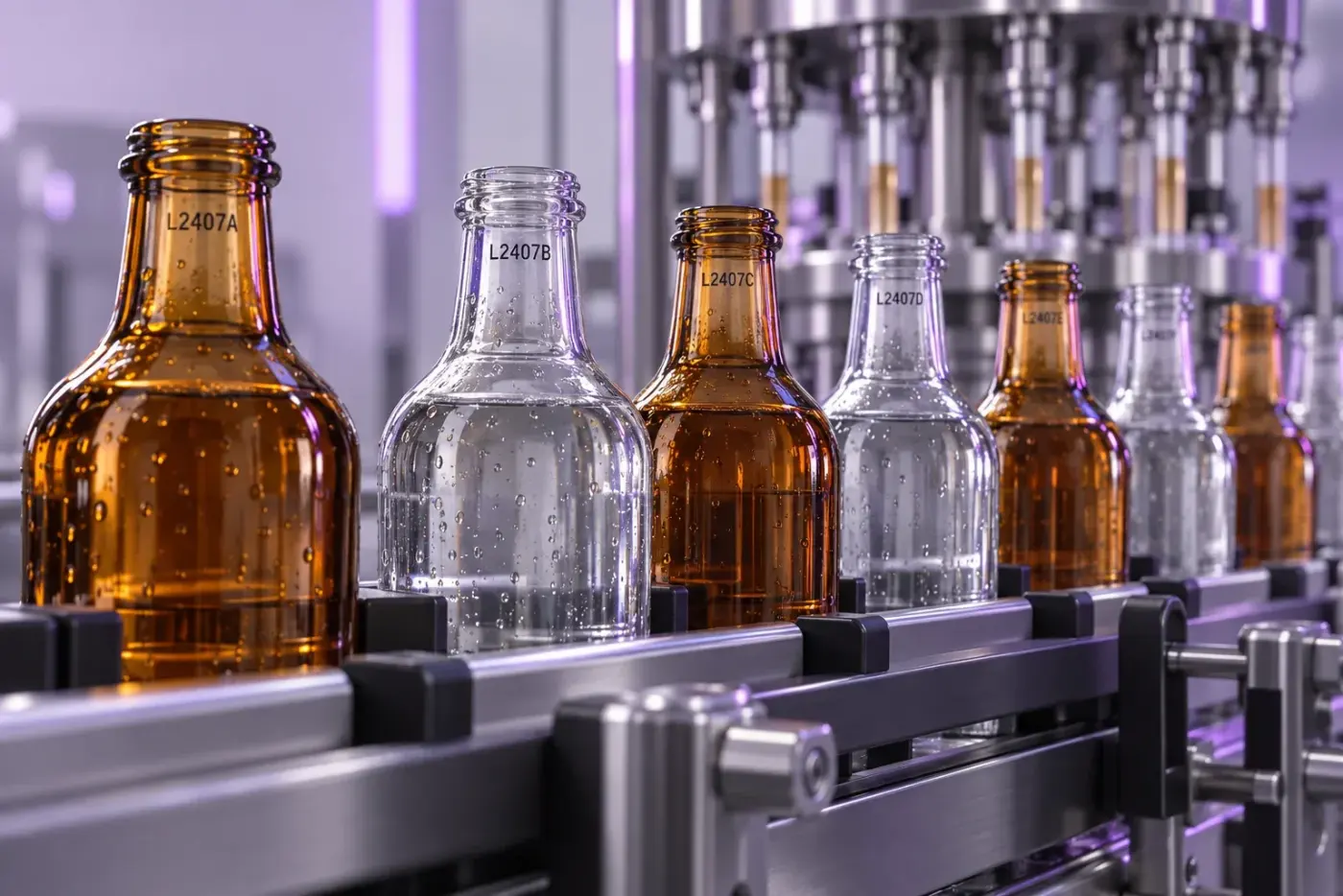
- picking up trays and food products in the food industry.
How does a vacuum-operated manipulator work?
A vacuum generator (pump or blower) draws the air out of a flexible lifting tube, at the end of which is the gripping head. The suction cup seals against the load, and the pressure difference contracts the tube and lifts the load. The operator holds the handle and adjusts the vacuum level: the load rises, stops or lowers, and the operator moves it sideways with one hand.
For the operator, the effect is that the load seems almost weightless. Gripping and releasing are done from the same handle, without hooks, straps or clamps to fasten, so cycles are fast: grip, lift, move, release.
The lifting tube is usually mounted on a slewing arm (jib crane on a column or on a wall) or on an overhead rail system, which covers a larger area. The choice depends on the area the operator has to serve: a single palletizing station or several pick-up and drop-off points.
How is the gripping head chosen for each load?
The gripping head is chosen according to the surface of the load: how flat it is, how much air it lets through and how large it is. The vacuum generator is then sized according to the grip.
| Load | Typical grip | What to watch for |
|---|---|---|
| Cardboard boxes | Single suction cup or several suction cups, for one or more boxes | Cardboard lets a little air through, and the box lid must be well glued. |
| Sacks | Gripping head dedicated to sacks, adapted to their shape | The sack material (paper, plastic, woven fabric) and dust on the surface. |
| Panels, boards, doors, glass | Frame with several suction cups, sometimes with rotation or tilting | The size, the rigidity and whether the load must be turned over. |
| Drums and containers | Suction cup on the lid or a grip adapted to the container | The drum must have a flat, closed surface. |
| Trays and food products | Grips adapted to the product, made of food-safe materials | Hygiene, cleaning and direct contact with the product. |
Materials that let air through, such as cardboard or paper sacks, require a generator with a higher flow rate to compensate for the losses. Smooth, airtight surfaces, such as glass or sheet metal, hold well with a lower vacuum. That is why a test with the real product is the safest way to confirm the grip.
What benefits do you get in the factory?
The equipment adapts to all sectors of activity to maximize productivity and product safety, while limiting the risk of workplace accidents. In practice:
- Ergonomics. The operator no longer lifts the load with their back but guides it. The station can also be staffed by people who could not lift heavy sacks or boxes by hand.
- Productivity. Gripping and releasing are fast, and the pace stays the same towards the end of the shift, when fatigue would slow down someone lifting by hand.
- Product safety. The load is gripped on its surface and lowered in a controlled way, without being dropped or knocked. Panels, glass and boxes arrive intact at their destination.
- Fewer workplace accidents. Repetitive lifting, twisting with the load in your arms and loads dropped on feet disappear.
If you want to estimate what manual lifting costs you today, with a sample calculation and the legal requirements, read our guide on the cost of manual handling of loads.
When is vacuum the right choice and when is it not?
Vacuum is the right choice when the load has a surface on which the suction cup can sit and has to be moved quickly, many times per hour. When the load has no such surface or has to be rotated or emptied, other equipment is a better fit.
| Equipment | Suitable for | Less suitable for |
|---|---|---|
| Vacuum manipulator | Sacks, boxes, panels, glass, fast cycles in palletizing and depalletizing | Loads without a gripping surface, very porous or irregularly shaped |
| Pneumatic manipulator with dedicated gripper | Parts, rolls, containers, off-center loads, precise positioning | Flows with very different loads, which would require many grippers |
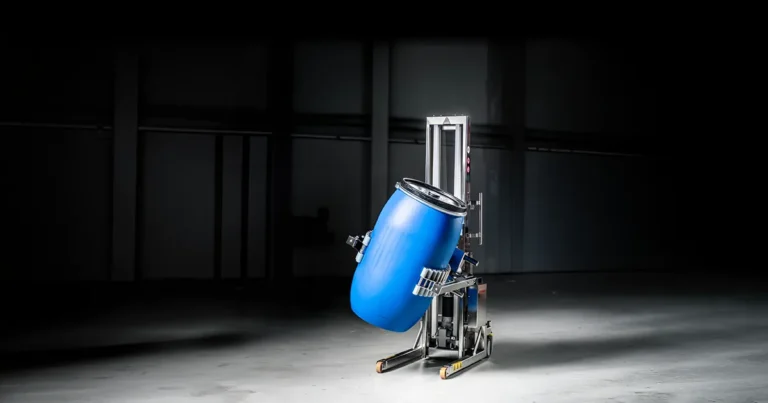
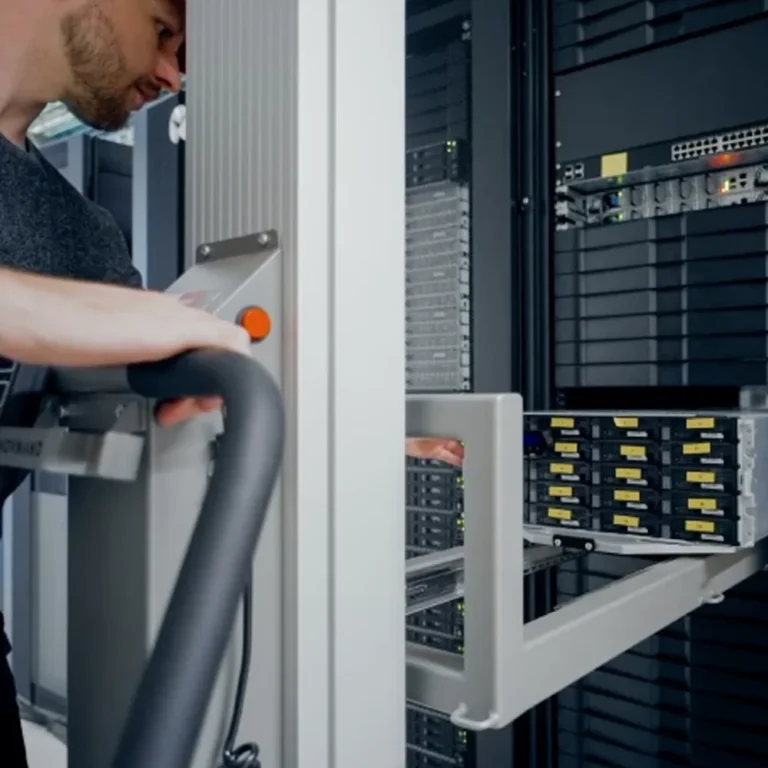
| Mobile electric lift | Loads carried between areas, lifting, rotating and emptying | Very fast cycles at the same station |
Pneumatic manipulators can in turn use suction cups as a gripping device, alongside clamps, magnets or forks. See the options under ATIS pneumatic manipulators and ergonomic lifts. For loads beyond the capacity of a vacuum manipulator or for rotating and emptying operations, the choice is made according to the application.
What data should you prepare for a quote?
Prepare the data on the load and on the workstation: the first determines the grip, the second the mounting and the vacuum generator.
- the list of loads, with dimensions, weights and photos, including the heaviest and the smallest;
- the material and condition of the surface: cardboard, paper, plastic, wood, glass, metal, dust or moisture;
- how many lifts you do per hour and per shift;
- where you pick up and where you set down the load: pallet, conveyor, machine, shelf, and at what heights;
- the area the operator has to cover and the height available under the ceiling or beams;
- environmental requirements: food hygiene, washdown, dusty areas.
Ask the supplier what happens to the load if the power supply is interrupted, and ask to see how it is held or lowered in a controlled way. It is a safety question to which you should get a clear answer before the quote.
How does Imark Sistem help you?
We start from your loads and your workstation. We analyze the photos and the data, propose the right grip and mounting, handle installation, commissioning and operator training, and provide service and spare parts. For factories in the food industry, we take hygiene requirements into account from the start.
See all industrial handling systems or send us a photo of the load directly. You can reach us at +40 21 255 71 74 or at office@imarke.ro.
Frequently asked questions about vacuum manipulators
How much weight can a vacuum manipulator lift?
The solutions presented handle boxes of different sizes up to 250 kg. The actual capacity depends on the gripping head, the surface of the load and the chosen configuration.
Can sacks be lifted with vacuum?
Yes. A dedicated gripping head is used for sacks, and the vacuum generator is sized according to the sack material, because paper or woven fabric lets more air through than plastic.
Can I lift several boxes at once?
Yes, with a gripping head with several suction cups, if the boxes are the same height and sit side by side. We check the grip on your boxes.
Where is the manipulator mounted?
On a slewing arm fixed to a column or a wall, for a single workstation, or on an overhead rail system, when the operator has to cover a larger area.
Can they be used in the food industry?
Yes. The equipment adapts to all sectors of activity, and for the food industry the grips are chosen from materials suitable for contact with products and for cleaning.