
Most of the information on a wine bottle comes from the label printer, together with the label. A few items, however, cannot be printed in advance because they change from one batch to the next: the lot number, the date of minimum durability on dealcoholised wines, the QR code that leads to the electronic label. These are marked on the bottling line itself. In this guide you will find what EU and Romanian legislation require, what to mark on the bottle, the case and the pallet, which technology fits each spot and what you gain by choosing well.
What does wine marking mean and how is it different from the label?

The label carries the information that stays the same for the whole wine: the name, the category, the origin, the alcoholic strength, the bottler. Marking adds the variable information at the moment of bottling: the lot, possibly the date and time, the batch-specific QR code or the logistics codes on the case and the pallet.
The difference matters in the winery. If you have the printer put everything that changes from one batch to the next on the label, you need a separate label run for each batch, and the labels left over from one batch cannot be used for the next. If you mark on the line, you use the same label stock for the whole product and add the variable part exactly when you know which wine goes into the bottle.
Marking happens at several levels: on the bottle or the label (the sales unit), on the capsule or cork (optional), on the cardboard case and on the pallet. Each level has different requirements and, in most cases, a different technology.
What does the law require for the information on a wine bottle?
Wine has its own labelling rules in the European Union, and since 8 December 2023 it must also meet the requirements for declaring ingredients and nutrition values, like other foods. The main acts that concern you as a bottler are:
- Regulation (EU) No 1308/2013 (common market organisation), as amended by Regulation (EU) 2021/2117: it sets the compulsory particulars on the wine label, including the list of ingredients and the nutrition declaration.
- Delegated Regulation (EU) 2019/33: it details how the compulsory particulars are presented. They appear in the same field of vision, in indelible characters, clearly distinguishable from the surrounding text and graphics. The lot number is an exception and may appear outside this field of vision.
- Regulation (EU) No 1169/2011 (food information to consumers) for the general rules, such as legibility and allergens.
- Directive 2011/91/EU on the lot: every packaged product carries an indication identifying the lot, preceded by the letter “L”, unless it is clearly distinguishable from the other particulars.
- Regulation (EC) No 178/2002: it requires food business operators to be able to identify who supplied them and to whom they delivered each product (“one step back, one step forward” traceability).
This guide helps you organise marking on the line. It does not replace a legal check of your label: confirm the exact list of particulars for each wine category with your consultant or with the competent authority.
What does the label printer apply and what do you mark on the line?
The practical rule is simple: what does not change goes on the label, what depends on the batch is marked on the line. The table below shows how the particulars are usually split.
| Information | Where it usually appears | Who applies it |
|---|---|---|
| Sales name, category, PDO/PGI, origin | Label | Label printer |
| Alcoholic strength, nominal quantity, bottler or importer | Label | Label printer |
| Allergens (for example “contains sulphites”) and energy value | Physical label | Label printer |
| List of ingredients and full nutrition declaration | Label or electronic label (QR code) | Label printer or marking on the line (batch QR) |
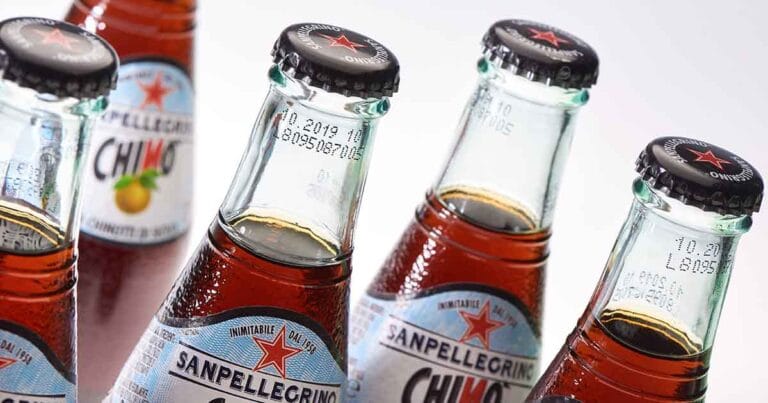
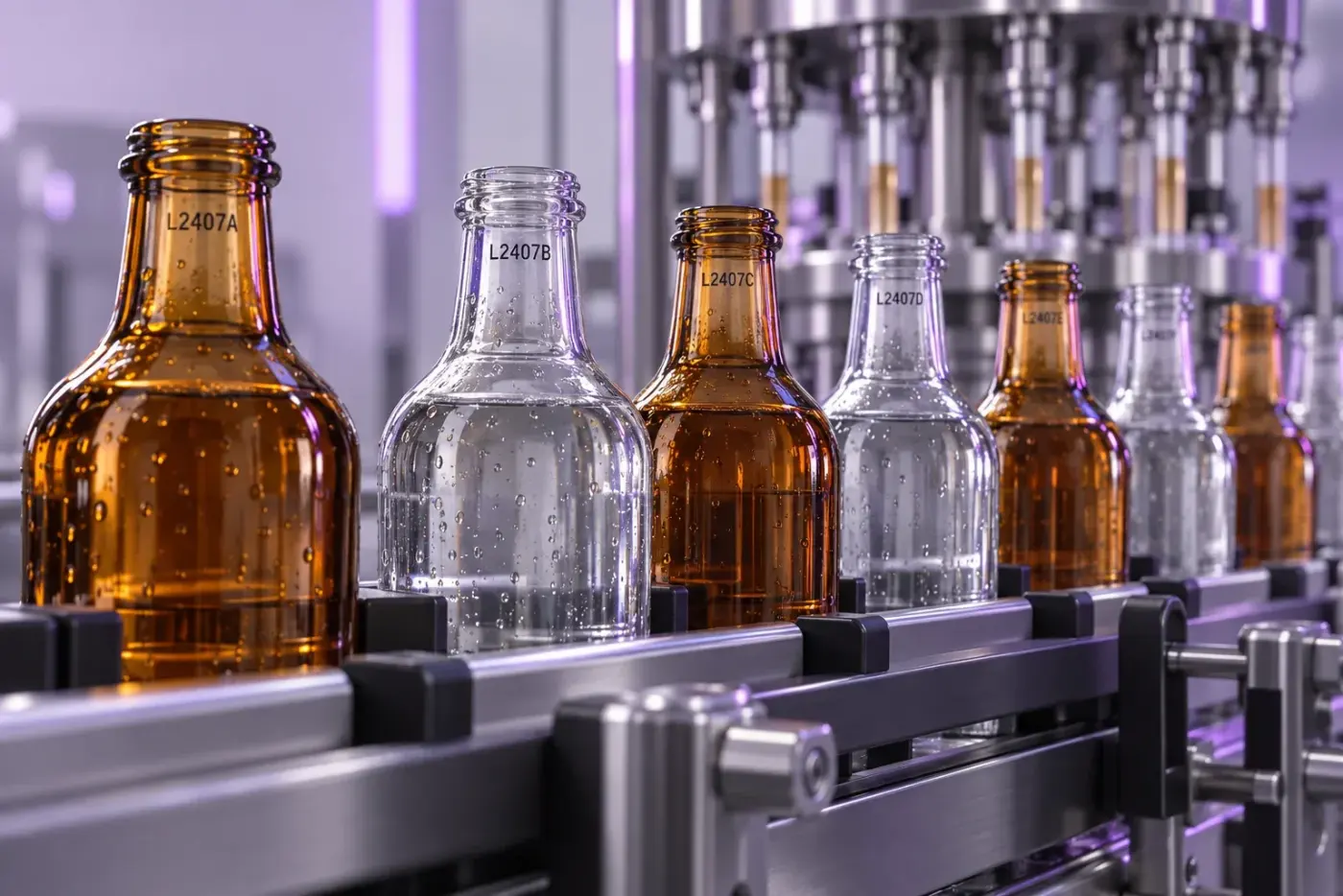
| Lot number | Bottle, label, capsule or cork | Marking on the line |
| Date of minimum durability (dealcoholised wines below 10% vol.) | Bottle or label | Marking on the line |
| Lot code, GTIN and logistics information on the case | Cardboard case | Marking or labelling on the line |
| Pallet label with SSCC code | Pallet | Print & Apply at the end of the line |
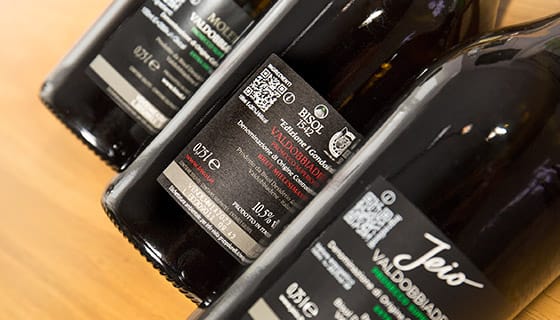
The QR code of the electronic label deserves special attention. If the wine’s composition changes from one blend to the next, a code printed in advance may lead to data that no longer matches the batch in the bottle. A code marked on the line and linked to the bottled batch solves the problem. The rules for the page the code leads to and how to work with dynamic QR codes are covered in our article on EU wine labelling rules.
What does the deposit return system (SGR) change for wine bottles?
In Romania, wine bottles are part of the deposit return system (SGR), operational since 30 November 2023 and run by RetuRO. Packaging in the system carries the SGR symbol and a barcode registered with the administrator, and the consumer pays a deposit of 50 bani, refunded when the packaging is returned.
For the winery, SGR changes the label first of all: the symbol and the barcode are printed on the label or back label, and producers have had to adapt their existing labels. On the line, what matters is that your marking does not cover the SGR barcode and does not interfere with reading it at the collection machines. Reserve a separate area for the lot and the QR code from the moment you design the label.
Where do you mark the wine bottle and with which technology?
The marking location decides the technology. On a wine line you usually have four options, and the choice depends on the colour of the glass, the label material, the line speed and how much text you need to mark.

- Directly on the glass, with continuous inkjet (CIJ). The printer marks without contact, on the shoulder or the base of the bottle, even at high speeds. On the dark glass often used for wine, white or coloured pigmented inks give good contrast. You will find more on this option in our guide to marking on glass.
- On the label, with a laser. A CO2 laser marks the lot or the QR code in a specially prepared area of the label, with no ink or ribbon. The contrast depends on the label, so test on your own labels first.
- On the label, with thermal transfer (TTO). A TTO printer mounted on the labelling machine prints the text and 2D codes on the label before it is applied to the bottle. It gives very sharp codes, well suited to QR.
- On the capsule or cork. Some producers mark the lot on the capsule or cork, with a laser or with ink, to keep the label clean. Test the capsule material: foil, aluminium and synthetic corks react differently.
How do you choose between CIJ, laser and TTO on a wine line?
There is no “best” technology for wine, only one that fits what you mark and where. The table compares the three options most often used on bottles.
| Criterion | CIJ (continuous inkjet) | Laser | TTO (thermal transfer) |
|---|---|---|---|
| Where it marks | Directly on glass, capsule, cork | On the label or capsule | On the label, in the labelling machine |
| Consumables | Ink and solvent | No ink or ribbon | Ribbon |
| QR codes | Possible, at lower resolution | Very sharp, on the prepared area | Very sharp |
| When it fits | Lot and date on the glass, high speeds, bottles of different colours | Lot and QR without consumables, lines that run a lot | A lot of text and 2D codes on paper labels |
| What to watch | Contrast on dark glass, adhesion on cold or wet glass | How the label reacts to the laser, protection of the work area | Label compatibility with the ribbon |
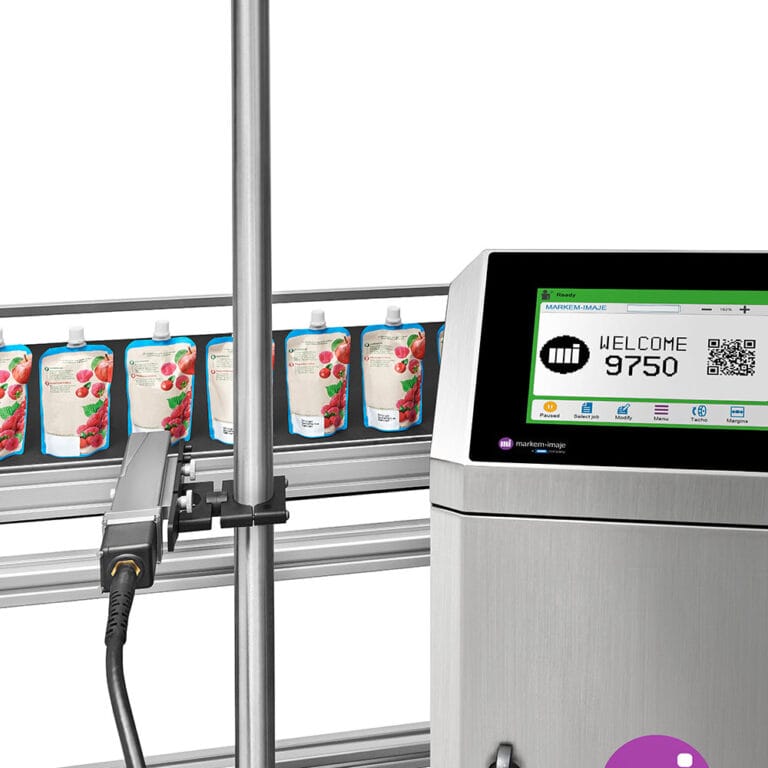
Two Italian wineries show that the choice differs from one producer to another. Mezzacorona uses Markem-Imaje SmartLase C350 CO2 lasers for the data on each bottle, while the Bisol1542 winery, part of the Lunelli group, uses Smartdate X65 TTO printers together with CoLOS software for the QR codes required by the EU rules.
You will find all of them on our pages for CIJ marking, laser marking and TTO marking.
The same line can use several technologies: for example, TTO for the QR code on the label and CIJ for the lot on the glass or on the case. What matters is that they all receive their data from the same source, so that the bottle and the case never show different lots.
What do you mark on the case and the pallet?

Cases and pallets never reach the consumer, but they do reach the warehouses of distributors and retail chains, which receive them by their codes. On the cardboard case you usually mark the product, the lot, the date and the case barcode (GTIN), with case inkjet printers or with automatically applied labels. On the pallet you apply the GS1 logistics label with the SSCC code, which uniquely identifies each pallet.
Marking cases on the line has an important advantage for wine: you can use blank cases, or cases printed generically for several products, and personalise each case only at packing. This reduces the number of case types you keep in stock. See our solutions for case and pallet marking and labelling.
How do you link the marking to the winery’s data?

Marking is only useful if it tells the truth about the batch. That is why the data should not be typed in by an operator at each printer, but sent from the winery’s system: the bottling order, the lot, the composition for the electronic label. Coding management software such as CoLOS sends the same data to every printer on the line and keeps a record of what was marked.
The second step is verification. A camera after the printer reads every code, confirms that the lot and the date are correct and that the QR code can be scanned, then rejects bottles with a wrong or missing marking. This way you find out about a problem within seconds, not from your customer. You will find more about these systems on our marking and verification software page.
What are the benefits of correct wine marking?
Well-organised marking protects you from legal risks, but it also brings direct gains in production and in your relationship with customers:
- Compliance for every batch. The lot, the date and the QR code match the wine in the bottle, even when the composition changes from one blend to the next.
- A single label stock. You no longer order separate runs for each batch or throw away leftover labels.
- Limited recalls. If a problem occurs, you recall only the affected batch, not the whole production of a product.
- Deliveries without rejections. Cases and pallets with legible codes pass the goods-in checks of distributors and retail chains without problems.
- Brand protection. Unique codes on the bottle make counterfeiting harder and help you track where your wine ends up. More on our brand protection page.
- Ready for GS1 Sunrise 2027. Retailers are gradually moving to scanning 2D codes at the checkout, and a GS1 Digital Link code can carry the product identification, the lot and a link to information in the same QR code.
How do you prepare a marking project in your winery?
A marking project starts from the product and the data, not from the printer. Gather this information before your first discussion with a supplier:
- Packaging: bottle colours, label and capsule types, case formats.
- What you mark and where: lot, date, QR code, on the glass, the label, the capsule, the case, the pallet.
- The line: maximum speed, free mounting positions, conditions (humidity, condensation on cold bottles).
- The data: where the lot and the composition come from (ERP, bottling sheets) and who updates them.
- Verification: how you confirm that every code is correct and what you do with rejected bottles.
- Samples: send real bottles, labels and capsules for marking tests.
With these answers, choosing the technology becomes a clear technical and economic decision, not trial and error on the line.
How can Imark Sistem help?
Imark Sistem is the official Markem-Imaje partner in Romania and works with producers in the beverage industry. We help you decide what to mark at each packaging level, test the marking on your bottles, labels and capsules and propose the right equipment: CIJ printers, lasers, TTO printers, case and pallet solutions, software and verification systems.
After installation, we provide original consumables, service and operator training. See all applications on our beverage industry page.
Frequently asked questions about wine marking
Is a lot number mandatory on a wine bottle?
Yes. Directive 2011/91/EU requires every packaged product to carry an indication of the lot, preceded by the letter "L" unless it is clearly distinguishable from the other particulars. The lot can appear on the glass, the label, the capsule or the cork and does not need to be in the same field of vision as the other compulsory particulars.
Do I have to mark a best-before date on wine?
Not for ordinary wine. The date of minimum durability is mandatory only for dealcoholised and partially dealcoholised wines with an alcoholic strength below 10% vol., under Regulation (EU) 2021/2117. Many producers still mark the bottling date for internal traceability.
Can I mark the electronic label QR code on the line?
Yes. The QR code can be marked on the label with a TTO printer or a laser, right on the bottling line, and linked to the bottled batch. The code then leads to the ingredients and nutrition values of the wine in the bottle, even if they change from one blend to the next.
Which technology should I use on dark wine bottles?
Directly on the glass, a continuous inkjet (CIJ) printer with white or coloured pigmented ink gives good contrast. If you prefer not to mark the glass, mark the lot on the label, with a laser or TTO, or on the capsule. A test on your own bottles shows which option reads best.
Can I use the same printer for bottles and cases?
Usually not: bottles and labels use CIJ, laser or TTO printers, while cases use case printers or Print & Apply systems. What must be shared is the data source: coding management software sends the same lot to every piece of equipment on the line.