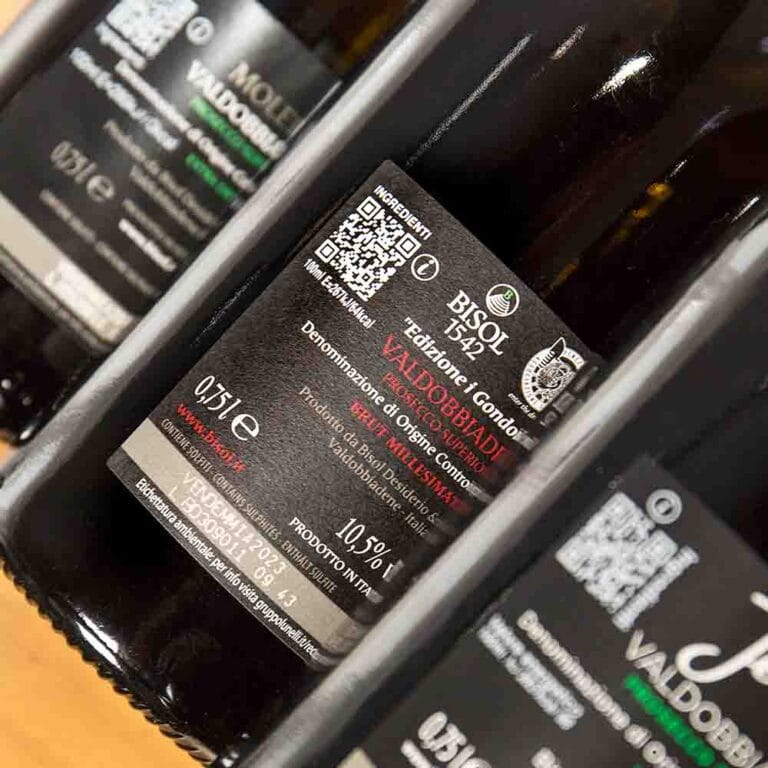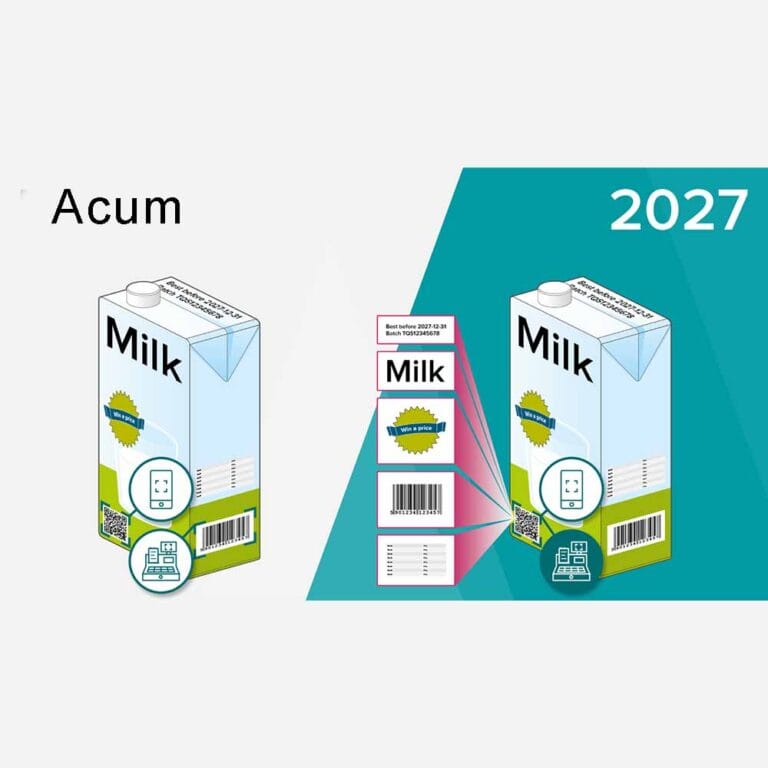

A pack can carry two kinds of QR code that look the same but do very different jobs. A marketing QR code always leads to the same address and is printed together with the pack artwork. A dynamic GS1-compliant 2D code, such as a QR code with GS1 Digital Link, carries the product’s identity plus data that changes from batch to batch, or even from one item to the next. That is why it is printed directly on the production line. The difference matters for the GS1 Sunrise 2027 transition, for traceability and for how you prepare your lines.
- Marketing QR code: a fixed link, the same on every pack, printed by the packaging printer; it takes the consumer to a campaign page.
- Dynamic GS1 2D code: carries the GTIN plus batch, expiry date or serial number; it changes on the line, so it is printed in the factory with industrial printers.
- GS1 Digital Link: the standard that writes these GS1 identifiers as a web address. The same code can be read at the checkout and by the consumer’s phone.
- GS1 Sunrise 2027: not a law, but the initiative through which retail checkouts become able to read GS1 2D codes.
- Imark Sistem is a GS1 Romania Solution Provider Gold 2026 and prints GS1 2D codes directly on production lines.
What is the difference between a dynamic 2D code and a marketing QR code?
The difference lies in what the code contains and who uses it, not in how it looks. An ordinary QR code usually sends you to a fixed destination. A GS1 code identifies the product and can connect it to different information that may change over time, without changing the code on the pack.
| Marketing QR code | Dynamic GS1 2D code (e.g. QR with GS1 Digital Link) | |
|---|---|---|
| What it contains | A fixed web address | The product GTIN plus variable data: batch, expiry date, serial number |
| Does it change? | No, it is the same on every pack | Yes, from batch to batch or from item to item |
| Where it is printed | By the packaging printer, with the artwork | On the production line, with industrial printers (CIJ, TIJ, TTO, laser) |
| Who reads it | The consumer’s phone | The checkout, logistics scanners and the consumer’s phone |
| What it is for | Campaigns, promotions, the brand page | Checkout sales, date control, precise recalls, traceability, plus consumer information |
| Does it replace the EAN barcode? | No | It is designed to, once retailers confirm they can read it |
In practice, a marketing QR code remains useful for campaigns. But if you want a single code for the checkout, logistics and the consumer, you need a GS1-compliant 2D code, and its variable data is printed on the line.

What is GS1 Digital Link?
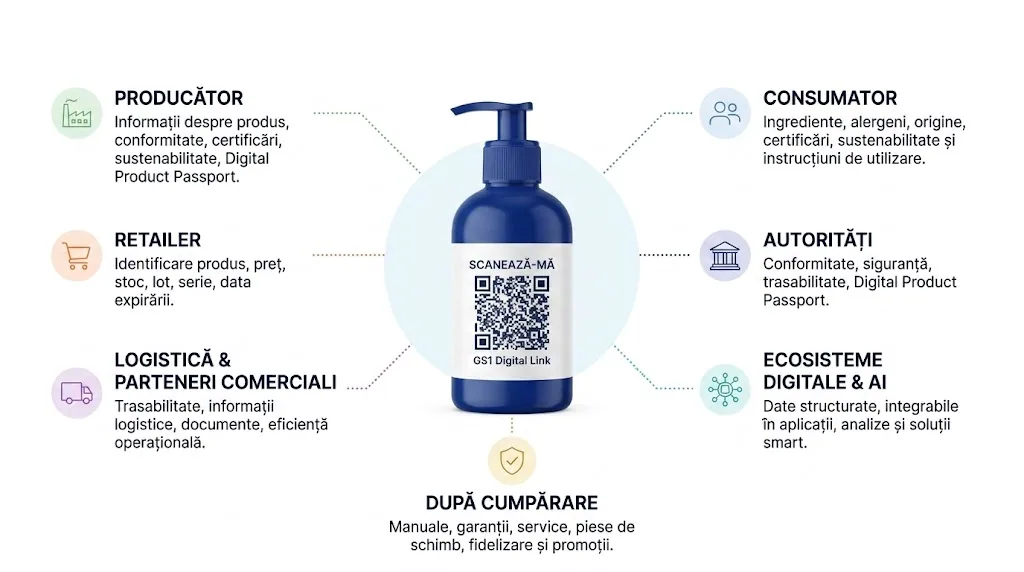
GS1 Digital Link is not the content but the standardised mechanism for reaching information. The standard writes GS1 identifiers, such as the GTIN, batch or serial number, as a structured web address. Any phone can open the address, and at the same time GS1-compatible systems, from the checkout to the warehouse, can interpret it.
The journey has five steps:
- The physical product receives a GS1 2D code.
- The code contains the GS1 identifiers: GTIN, batch, serial number, date.
- Scanning works with any device: checkout scanner, warehouse terminal or phone.
- GS1 Digital Link turns the identifiers into a standardised web address.
- The destinations can be many: product information, instructions, ingredients and allergens, promotions, traceability, recalls, the digital product passport.
What does a GS1 Digital Link address look like?
A GS1 Digital Link address has a fixed structure, in which each piece of information is preceded by a GS1 Application Identifier (AI). For example:
https://example.com/01/09524810000339/10/LOT123/21/00987?17=271231
| Part of the address | What it means |
|---|---|
https://example.com | The domain, the entry point (resolver) for accessing data |
01/09524810000339 | AI 01 = the GTIN, the global product identifier |
22/… | AI 22 = the product variant, where relevant |
10/LOT123 | AI 10 = the production batch |
21/00987 | AI 21 = the serial number of the item |
?17=271231 | AI 17 = the expiry date (YYMMDD) |
The GTIN part stays the same for all products of the same type. Batch, serial number and date change. That is why the code cannot be printed once by the packaging printer: the variable data is printed on the line, from the production system or ERP. Following the syntax does not automatically mean the domain runs a GS1-conformant resolver, nor that all product information sits inside the code.
What does a resolver do?
The resolver is the bridge between the scan and the right destination. It receives the address read from the code and decides where to send the user, depending on who scans, where, when, in which language and from which device. Examples of routing:
- the consumer lands on the product page;
- an internal operator sees the batch traceability data;
- for compliance, the code leads to the digital product passport;
- in another market, the code shows content in the local language.
Content can be updated without reprinting the code, as long as the identifier and address remain valid.
What does GS1 Sunrise 2027 mean?
GS1 Sunrise 2027 is not a law and does not make all 1D barcodes invalid in 2027. It is the global initiative through which retail prepares to read and process GS1 2D codes at the point of sale, alongside existing linear barcodes.
- The timeline differs by market, retailer and product category.
- During the transition, many packs will carry both the current EAN barcode and a 2D code.
- The linear barcode can only be removed once trading partners confirm they can read the new code.
- In Romania, GS1 Romania has been running a pilot since summer 2026 with more than 50 companies, to build a national implementation guide.
Details about the standard and the pilot are on GS1 Romania’s GS1 Digital Link page. Practical steps for a plant are in our GS1 Sunrise 2027 guide.
How does it relate to legislation and the digital product passport?
GS1 standards are not imposed by law. They can, however, support compliance where requirements exist:
- Food, beverages and medicines: existing sector requirements apply for traceability, batch, serial number, expiry and consumer information.
- Packaging (PPWR regulation): packaging and recycling information. The regulation does not explicitly require GS1 Digital Link, but it favours standardised, open digital data carriers.
- Digital product passport (DPP, ESPR regulation): the product’s digital file, with data on origin, materials, repairability, recycling and compliance. It applies progressively to certain non-food categories, on an indicative timeline: iron and steel (end of 2026), batteries (February 2027), then construction products, textiles, aluminium, tyres (2027), furniture (2028) and mattresses (2029). Food, feed and medicines are excluded from ESPR.
In short: Sunrise 2027 prepares the scanning, GS1 Digital Link makes the connection, and the information delivered depends on the product category and the requirements that apply to it.
QR, Data Matrix or GS1 DataMatrix?
- QR code with GS1 Digital Link: suits products that must be read both at the checkout and by an ordinary phone camera.
- Data Matrix with GS1 Digital Link: useful where space is tight; phones read it less often directly from the camera app.
- GS1 DataMatrix: uses classic GS1 syntax, with no web address. It is widespread in the supply chain and recommended for regulated healthcare applications, but does not open a page on a phone by itself.
How do you print a dynamic 2D code on the line?
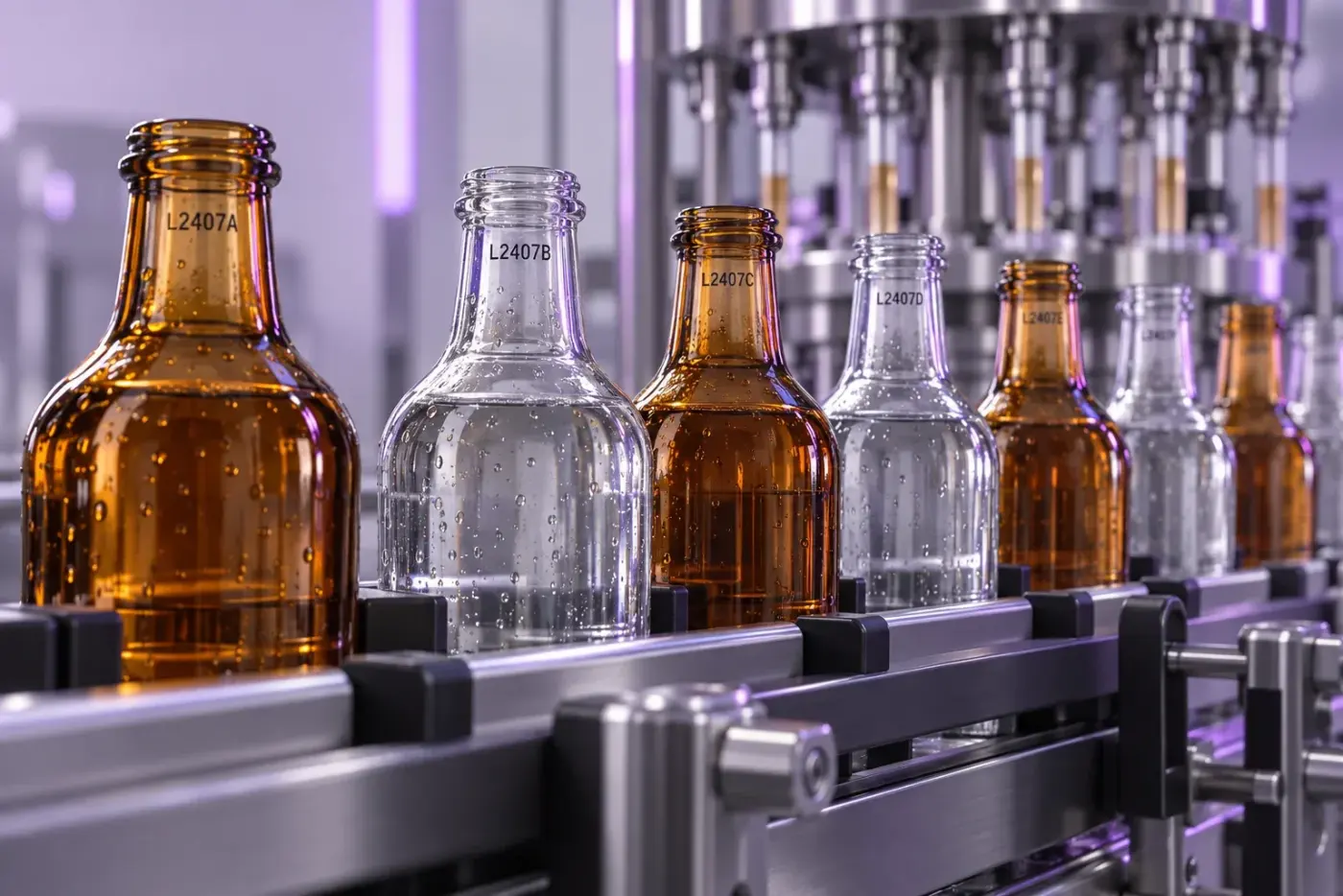
Because batch, date or serial number change, the code is printed in the factory, directly on the pack or on a label, with data from the production system. The technology is chosen by substrate and speed: continuous inkjet (CIJ) on bottles, cans and cartons, thermal inkjet (TIJ) on cartons, thermal transfer (TTO) on flexible film, laser on PET, cartons or metal, and Print & Apply for labels on cases and pallets.

A code that looks good is not always a correct code. It is worth checking with a vision system or a verifier that it is readable and contains the right data. All technologies are on our GS1-compliant dynamic 2D codes page.
How do you prepare?
- Decide what the code is for: checkout, logistics, traceability, consumer information or campaigns.
- Choose the symbol and syntax: QR or Data Matrix, with GS1 Digital Link or classic GS1 syntax.
- Decide the variable data: batch, expiry, serial number, and where it comes from at print time.
- Set up the domain, landing pages and, if needed, a resolver.
- Integrate printing with your ERP, MES or traceability system.
- Test with your retailers and partners, then verify the quality of the printed code.
Why work with Imark Sistem?

Imark Sistem is a GS1 Romania Solution Provider Gold 2026 and the official Markem-Imaje partner in Romania. We help you with:
- application analysis and choice of marking technology;
- integrating printers on your production lines and managing variable data;
- checking code readability and quality;
- pre-launch testing and local technical support.
For a GS1 Digital Link project we recommend also working with GS1 Romania and your trading partners, so that identifiers, data structure and scanning scenarios are validated before production.
Frequently asked questions about GS1 Digital Link
Is every QR code a GS1 Digital Link?
No. A QR code is GS1 Digital Link only if the address inside follows the GS1 structure, with the GTIN and other identifiers in the positions defined by the standard. An ordinary marketing QR code with a campaign link is not.
Do I need to change my product’s GTIN?
No. GS1 Digital Link uses the GTIN you already have. The GTIN is the product identifier, not a barcode type: EAN-13 and the GS1 QR code simply carry it in different forms.
Do I have to reprint the code when the information changes?
No, if the information is online. You update the page or the resolver rules, and the code on the pack stays the same. The data inside the code, such as batch and expiry, changes with every batch anyway, at printing on the line.
Will the EAN barcode disappear in 2027?
Not automatically. During the transition, packs can carry both codes. The EAN is removed only after retailers and partners confirm they read the 2D code correctly.
Talk to a specialist
If you are preparing the move to 2D codes or evaluating GS1 Digital Link, send us your products, packs and the data you want to encode. We will propose a printing and verification solution. Call us on +40 21 255 71 74 or write to office@imarke.ro.
Sources: GS1 Romania, GS1 Digital Link; GS1 Digital Link Standard; GS1-Conformant Resolver Standard; GS1 2D Barcodes at Retail Point-of-Sale Implementation Guideline.