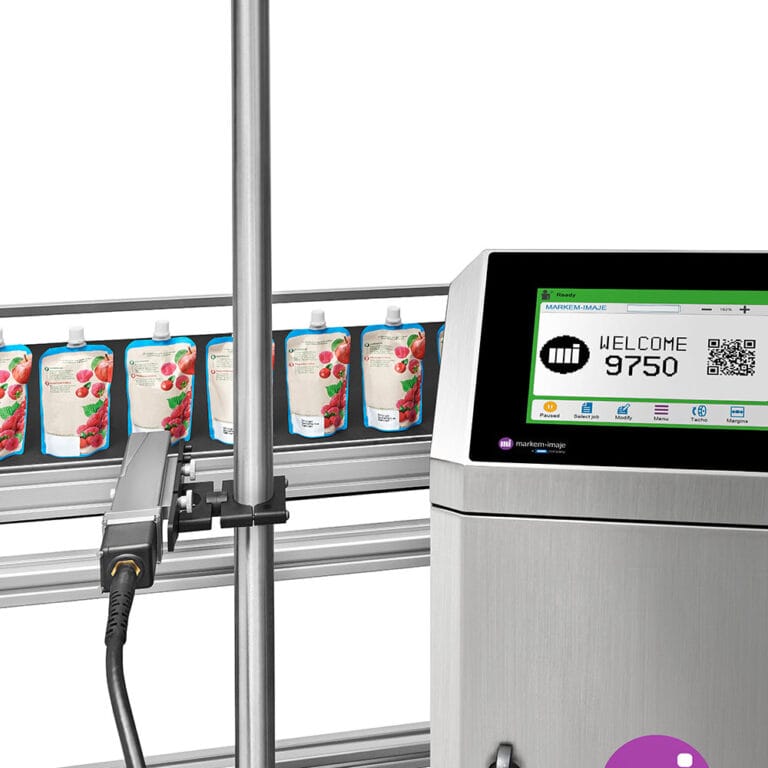
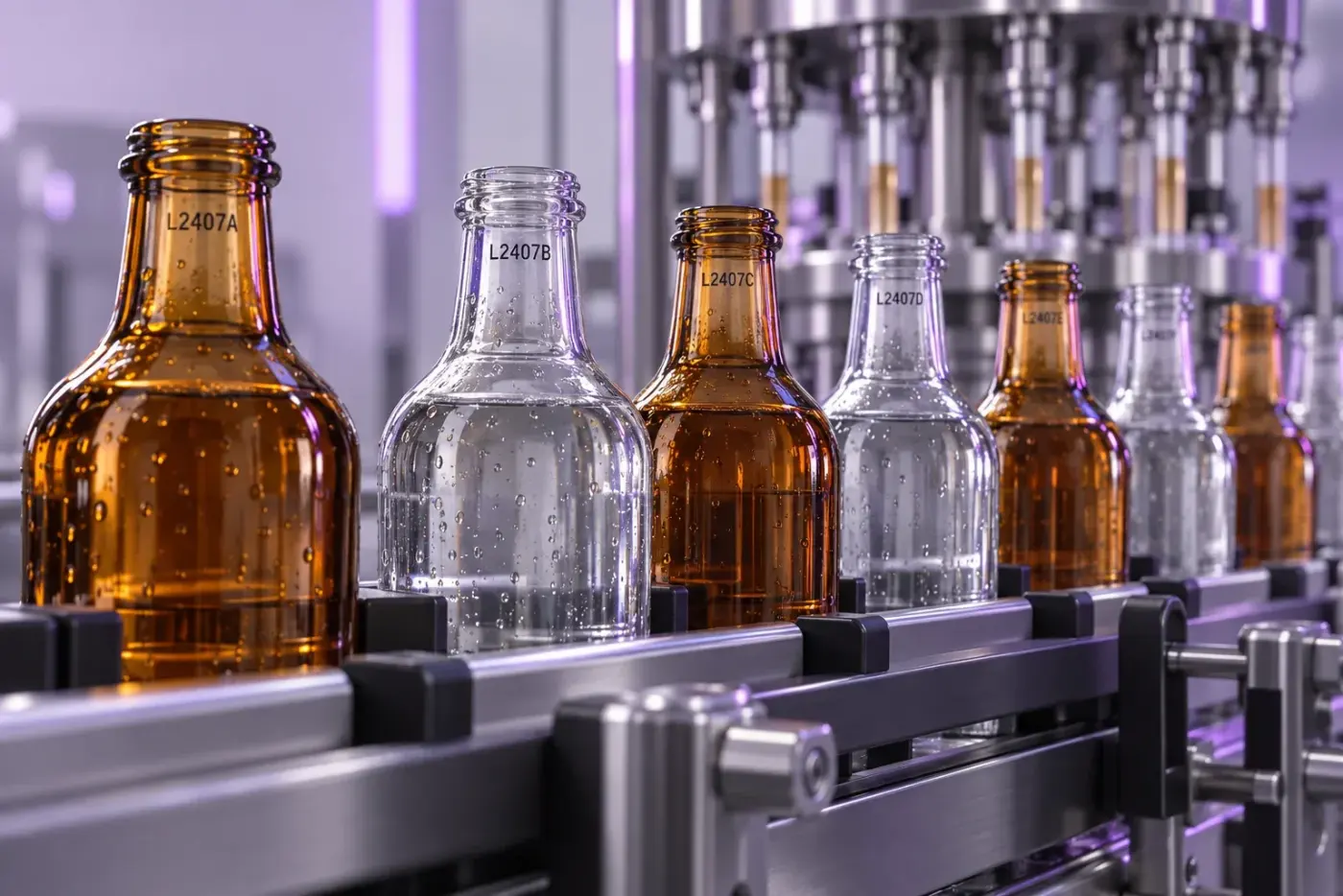

In a food & beverage plant, marking and coding equipment often looks like a secondary part of the production line. It works, it prints, it leaves visible marks on the packaging, and that is it. But when maintenance costs creep up, when unplanned stops become more frequent or when a quality audit flags non-conformities, the reality becomes clear: outdated marking equipment has a real cost that far exceeds its residual value.
This article looks at the main categories of hidden costs and helps you understand when upgrading becomes more cost-effective than ongoing maintenance.
| Hidden cost | Order of magnitude | What it means |
|---|---|---|
| Unplanned stops (downtime) | EUR 5,000–20,000 per hour | Average cost of an unplanned stop on a food & beverage production line |
| Excess consumables | +30% | Extra ink and solvent compared with equivalent new equipment |
| Rejects and returns | Entire batches | Products rejected by the retailer, commercial renegotiations, QA investigations |
| GS1 2D compliance | 2027 | Major EU retailers ask for GS1 2D compatibility, which older equipment does not support |
1. The cost of unplanned line stops

Manufacturing industry studies estimate that unplanned downtime costs on average between EUR 5,000 and 20,000 per hour, depending on line capacity and the value of the finished product. Old marking equipment is among the main causes of these stops:
- worn printheads that need frequent replacement and repeated manual calibration;
- spare parts that are hard to source or unavailable for discontinued models;
- longer response times from technical service for equipment without active support;
- repeated manual settings that take up operator time and introduce variability in quality.
A single major downtime incident can exceed the cost of new marking equipment. Yet manufacturers tend to count only the cost of the repair, not the total cost of the lost production hours.
2. Excess consumables: the invisible monthly cost
Older coding equipment does not benefit from the improvements in ink and solvent consumption made in recent generations. The difference can be significant:
| Indicator | Value |
|---|---|
| Equipment older than 8 years | Ink consumption: 100% reference. Spare parts expensive or hard to find. |
| New Markem-Imaje equipment | Ink consumption 25–30% lower than the reference, with better print quality. |
| Estimated annual saving | EUR 2,000–6,000 per year per unit, at average production volume. |
| Payback through consumables | Partial, within 12–24 months, depending on production volume. |
Over a year, this difference can amount to thousands of euros in consumables. Combined with the GRENKE operating lease options available through Imark Sistem, upgrading becomes affordable without a major upfront investment.
3. Rejects, non-conformities and product returns

Print quality degrades gradually as equipment wears, often without the operator noticing straight away. The direct consequences include:
- products rejected at the retailer’s goods-in because of unreadable or incomplete codes;
- costly returns and commercial renegotiations that eat into profit margins;
- loss of entire batches if identification cannot be verified in the traceability system;
- internal investigations and manual corrections that consume QA resources;
- damaged relationships with trading partners and the risk of losing retail listings.
In the food & beverage industry, where stock turns over quickly and margins are thin, even a small percentage of rejects can change a product’s profitability.
4. Legal and compliance risks: GS1 2D and traceability

European food traceability rules are becoming stricter, and the pressure comes both from legislation and from major retailers:
- the transition to GS1 2D codes (QR codes and DataMatrix) requested by major EU retailers by 2027 calls for equipment able to print and verify these advanced formats;
- the EU Regulation on the provision of food information to consumers (Regulation No 1169/2011) and its updates set strict requirements for the legibility and completeness of data on the pack;
- HACCP systems and IFS/BRC audits include checks on marking equipment and can raise major non-conformities if the equipment does not perform to standard.
Equipment that does not support GS1 2D is not just an operational disadvantage: it can become a real commercial roadblock, meaning you cannot deliver to certain retailers or pass mandatory quality audits.
How to calculate the real TCO: the complete formula
The total cost of ownership (TCO) of marking equipment has six components:
| Component | How to calculate it |
|---|---|
| Maintenance and spare parts | Annual cost of interventions, plus parts that are hard to source for older models |
| Consumables (ink, solvent, ribbons) | Monthly cost × 12 months, compared with equivalent new equipment |
| Downtime | Lost hours × cost per hour. The most underestimated element of TCO, often left out of calculations |
| Rejects and returns | Product cost + transport + commercial renegotiations + QA resources |
| Compliance risk | Probability × potential financial impact: fines, recalls, lost listings |
| TCO break-even point | Often within 12–18 months: the point at which maintenance exceeds the cost of upgrading |
A simplified formula for the upgrade decision:
Annual TCO of the old equipment > (lease payment for new equipment × 12) + new consumables
If this condition is met, upgrading is more cost-effective than continuing to maintain the old equipment.
Imark Sistem can carry out this analysis free of charge for your production line, including GRENKE operating lease financing options that remove the need for a major upfront investment.
Imark Sistem solutions: from analysis to implementation

Imark Sistem offers a structured process for assessing and upgrading marking equipment:
- Free technical audit: assessment of the current equipment condition and identification of operational risks.
- Tailored TCO calculation: comparison of the real cost of ownership with the upgrade alternative.
- A solution proposal that fits: Markem-Imaje equipment, chosen according to the application and budget.
- GRENKE operating lease financing: upgrading without a major upfront investment, with fixed monthly payments.
- Installation, training and local technical support: our own team in Romania, with national coverage.
Conclusion
Outdated marking equipment is never “free” just because it no longer needs investment. The real costs (downtime, excess consumables, rejects and compliance risks) build up quietly and can quickly exceed the value of new equipment.
The right time to upgrade is not when the equipment fails completely, but when the annual TCO of the old equipment exceeds the cost of the new alternative. That moment often comes sooner than expected.
Request a free TCO analysis for your line. The Imark Sistem team assesses your existing equipment free of charge, calculates the total cost of ownership and proposes the right upgrade solution, with no consultancy fees. Write to us at office@imarke.ro or call +40 21 255 71 74.
See also our full range of marking applications.