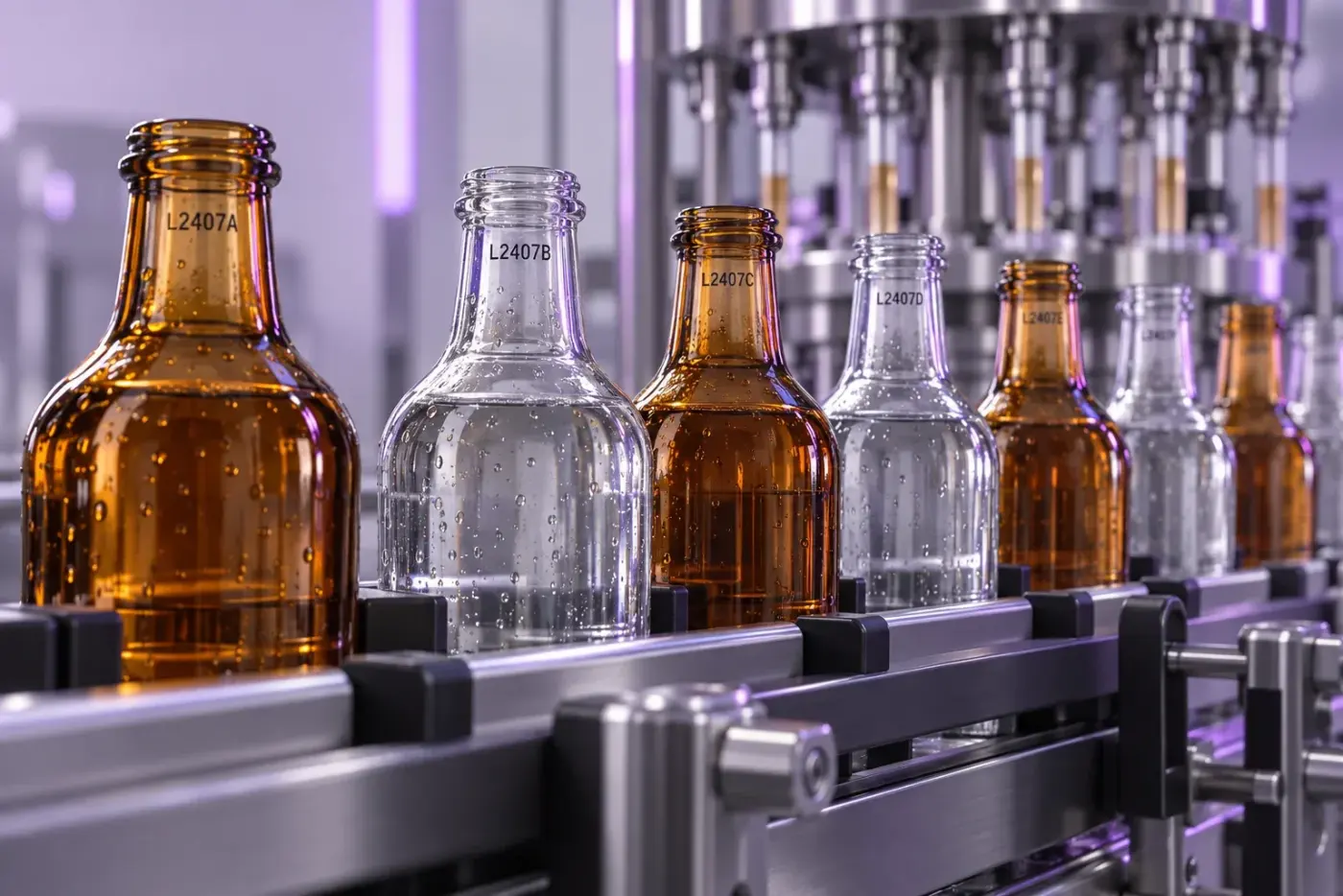

On a bottling line, a bottle with the wrong cap, a crooked label or an unreadable code leaves for the customer just as easily as a good one. Vision systems use cameras and software to check every bottle in the flow and remove non-conforming products from the line. Explore below some of the applications used in glass packaging production, where vision systems are used to improve quality and reduce costs, and find out how to prepare such a project.
What does a vision system do on a glass packaging line?
A vision system automatically performs, at line speed, the visual check that an operator would otherwise do. It consists of an industrial camera, lighting chosen for the application, image analysis software and the connection to the line: a sensor that triggers the image and a signal to the reject system.
For each bottle, the camera takes an image, the software compares it with the rules set for the product currently running and decides: the bottle moves on or is rejected. Unlike an operator, the system does not get tired towards the end of the shift and can store images and defect statistics, which are useful when you are looking for the cause of a problem.
The camera analyzes the visible surface, not the inside of the product. For foreign bodies inside the jar or bottle, such as a glass shard, the solution is X-ray inspection, not the vision system.
Watch the applications on video:
How do you check that the right product has gone into the right bottle?
Checking the content by cap and label color

On lines that bottle several product variants, the color of the cap and label tells you which product is in the bottle. The camera checks that this combination matches the variant running at that moment.
The risk arises mainly at product changeover: caps left in the hopper from the previous batch, a wrong label reel fitted in a hurry or bottles left on the conveyor. A product carrying another variant’s label is not just an image problem. If the recipes differ in allergens, such a mix-up can lead to a batch recall. Automatic checking of every bottle replaces the spot check made at the start of the batch and catches exactly the units that slip past a visual check.
How do you check the codes on the bottle?
Verifying the printed barcode and 2-D code

The system reads the barcode or 2D code, checks that it can be read and that it has the expected content for the product on the line. A barcode that does not scan at goods receipt or at the checkout means rejections and complaints, and a 2D code used for traceability does not do its job if it cannot be read. The check is made immediately after printing, so a printer deviation, for example a partially clogged nozzle or poor contrast, shows up after a few bottles, not after a whole batch.
Verifying the expiry date marking

The expiry date and batch are printed on the line, directly on the bottle, the cap or the label. The camera checks that the marking is present, legible and carries the correct date and batch. On dark glass, marking with white ink is often used, and inline code verification is covered in detail in the article on checking code presence, readability and precision.
How do you check bottle filling and closing?
Locating the bottle position for filling

Here the vision system does not reject products, it guides the machine. The camera locates the exact position of the bottle and sends the coordinates to the filling or handling equipment, so that it works exactly on the bottle neck. The application is useful where bottles do not always arrive in the same position.
Checking the fill level and cap positioning

With clear glass, the camera sees the liquid level and rejects underfilled or overfilled bottles. The same image is used to check that the cap is present, sits straight and is fully screwed on. A crooked or loose cap can mean a bottle leaking in the case or a product that spoils before its expiry date.
How do you check the label on the bottle?
Checking label position and orientation

The camera checks that the label is present, at the correct height, straight, free of creases or lifted corners, and correctly oriented relative to the other elements of the bottle, for example the back label or an embossing in the glass.
On the shelf, the bottle is the first image of the brand. A crooked or wrinkled label looks careless, even if the product inside is perfect, and with premium drinks customers notice these details immediately. Most label defects occur after a format change, at the start of a new reel or when applicator parts wear. A vision system installed after labeling shows you immediately when a deviation begins, before a whole pallet of bottles to be relabeled builds up. For label application, see our labeling solutions.
Why is glass a difficult material for cameras?
Because glass reflects, is transparent and has curved surfaces, and all of these complicate the image. A few situations taken into account in the project:
- reflections on glossy glass can hide a code or a label edge; this is solved by choosing the lighting and the camera angle;
- transparency helps when checking the fill level, but makes a transparent element on a transparent background harder to see;
- colored glass changes the contrast: what is clearly visible on flint glass can be hard to read on green or amber glass;
- curvature distorts codes and labels on the bottle body;
- condensation on cold-filled bottles can appear in the image as a defect;
- orientation: round bottles arrive on the conveyor rotated at random, so several cameras are sometimes needed to see the whole circumference.
For this reason, the configuration is set up on your samples, with all glass colors and all product variants.
How do you prepare a vision project for your line?
Start from the defects that cost you the most, not from the camera. Prepare for the first discussion:
- The list of defects you want to catch, in order of cost: complaints, returns, relabeling.
- Samples, good and defective, from each product variant, glass color and cap type.
- The position on the line: after filling and capping, after labeling or after coding. Each check has its place.
- The line speed and the spacing between bottles.
- Rejection: how bottles leave the flow and where they are collected.
- Data: whether you want images of rejected products, statistics per batch and a connection to the plant systems.
- Product changeovers: how many recipes need to be configured and who selects them.
A short video of the area where you want to install the camera helps us understand the space, the existing lighting and the way the bottles travel.
How does Imark Sistem help you?
We start from your bottles and your line: we analyze the defects, test the checks on samples and propose the right configuration. Because we also work with marking and labeling equipment, we can link the check to the equipment that prints the code or applies the label. We handle installation, commissioning, operator training and service.
See also the other solutions for the beverage industry. For more details, contact us today on +40 21 255 71 74 or at office@imarke.ro.
Frequently asked questions about vision systems for bottles
What can a vision system check on a bottle?
The cap and label color, the barcode and 2D code, the expiry date, the fill level, the cap position, and the label position and orientation. It can also locate the bottle for filling.
Can a vision system find glass shards inside the jar?
No. The camera analyzes the visible surface. For foreign bodies inside the container, X-ray inspection is used.
Does it work on colored bottles?
Yes, but the lighting and settings are chosen for each glass color. That is why we test on samples from all product variants.
Can it be installed on an existing bottling line?
Usually, yes. The camera is mounted on the conveyor at the point where the check is made, and rejection is integrated into the existing flow. Space and speed are checked before the quotation.
What happens to the rejected bottles?
They are automatically removed from the flow and collected separately. The system can store images and defect statistics, so you can find the cause of the problem more easily.